Showing posts with label Stock Market. Show all posts

Thursday, January 21

Dear White House, please explain your plan for handling 'The Bush Tax Cuts'

It is nice to see that the White House is acknowledging that they have lost touch with 'the people'.
President Obama said today that he believes he lost a direct connection to the American people in his first year in office because he focused too heavily on policymaking.

"If there's one thing that I regret this year is that we were so busy just getting stuff done and dealing with the immediate crises that were in front of us that I think we lost some of that sense of speaking directly to the American people about what their core values are and why we have to make sure those institutions are matching up with those values," Obama told ABC News' George Stephanopoulos in an exclusive interview at the White House. - ABC News
Looking at his comment above, it is all about their failure to speak to the people. This kind of highlights a huge problem for this Administration in that they are not listening to the people. For me, I do not think the President and his team were ever listening to the people. At least not since Obama's disastrous encounter with 'Joe the Plumber'. Really, how is it possible to lose touch with the people in under a year. Given that the White House has held parties every third day since moving in, you'd think that they would be well in touch with the people. (clearly, they are inviting the wrong people to their parties... Me, I'm available.)

But OK, now they claim to be listening. Well one issue that I would like to see them get resolved is the 'Bush Tax Cuts' which are set to expire at the end of the year:
The central provisions of these landmark tax bills are scheduled to expire over the next five years, which means that taxes will rise dramatically for most taxpayers. Between now and January 1, 2011,

* Tax rates will rise substantially in each tax bracket, some by 450 basis points;

* Low-income taxpayers will see the 10-percent tax bracket disappear, and they will have to pay taxes at the 15-percent rate;

* Married taxpayers will see the marriage penalty return;

* Taxpayers with children will lose 50 percent of their child tax credits;

* Taxes on dividends will increase beginning on January 1, 2009;

* Taxes on capital gains will increase, also beginning on January 1, 2009; and

* Federal death taxes will come back to life in 2011, after fading down to nothing in 2010.

- Heritage.org
In light of the election defeat in MA, and the ongoing problems with the economy, I think the President needs to change his stance on extending the 'Bush Tax Cuts' instead of his BS excuse that by not extending them he is not raising taxes because they were set to expire prior to taking office. This basically puts the blame on Bush (again) and Congress for not enacting permanent tax cuts.

However, that excuse is not going to wash with voters when their take home pay is cut because they have to pay more in taxes. And nobody is going to blame anyone but the Democrats in power, including the President.

This is yet one more issue that both Congress and the White House need to be confronted with.

I would like to see this resolved. We are looking to buy a house this year. Having our taxes go up next year just makes affording a house that much more difficult.

--------------------
Add to Google
--------------------

Wednesday, January 7

Short Selling Harms Company Stockholders (Illustrated)

The Wall Street consensus is that the practice of short selling is an accepted market strategy.
In finance, short selling or "shorting" is the practice of selling a financial instrument that the seller does not own at the time of the sale. Short selling is done with intent of later purchasing the financial instrument at a lower price. Short-sellers attempt to profit from an expected decline in the price of a financial instrument. Short selling or "going short" is contrasted with the more conventional practice of "going long" which occurs when an investment is purchased with the expectation that its price will rise.

Typically, the short-seller will "borrow" or "rent" the securities to be sold, and later repurchase identical securities for return to the lender. If the security price falls as expected, the short-seller profits from having sold the borrowed securities for more than he later pays for them but if the security price rises, the short seller loses by having to pay more for them than the price at which he sold them. The practice is risky in that prices may rise indefinitely, even beyond the net worth of the short seller. The act of repurchasing is known as "closing" a position. Short Selling is often used in hedge funds. - Wikipedia
We all know this. But did you ever think that shares could be borrowed multiple times? Well they can.


Imagine a company that has ten shares of stock. I own five of the shares and you own five. Your shares are borrowed by a broker who then re-sells them. The end result, I own five shares, you own five shares, buyer ‘x’ owns five shares. That totals fifteen shares. Short Selling has the effect of increasing the total number of shares available for a corporation well above the total number of authorized shares. The way the professionals on Wall Street reason that this is OK is because somewhere there is shorter ‘y’ who owes those fives shares and is expected to buy them at some point in the future. (And yet, the market regulators only publish that number owed once a month instead of daily like other market trading statistics.)

In this basic example above, the total number of shares available was increased by 50%.
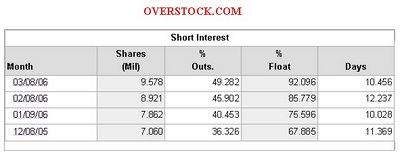
However, there are plenty of stocks with five and even ten percent of the stock ‘float’ shorted. That increases the number of shares available by millions. The only group that should have the right to increase the authorized share capital of a corporation are the owners themselves. Think 50% is an unrealistic number? Take my post from April, 2006 (Are Brokers 'Screwing' Stockholders through Short Selling?) which covered the extreme case of OVERSTOCK.com where :
Overstock.com has issued about 19 million shares of stock. The latest short interest figures from the stock market have about 9.5 million shares short, about 49% of the total. This number is even more impressive when you figure that not all 19 million shares are available for shorting. According to Overstock, there are only 8,970,394 (10 March) registered in the electronic exchange, so that would be the theoretical maximum available to short. The reminder of Overstocks stock either has been issued as paper certificates, and not eligible for shorting unless a broker borrows them and adds them into the electronic register, or the shares have not been issued in any form by the Company.

Not very fair is it? Now this situation is with the shares being properly 'borrowed'. I question the validity of being able to borrow a stock to short it they way the market does it, especially considering that the accounts still show the stock as being held by the account even if the shares have been borrow. This would be like letting your friend borrow your car and it still being in your driveway despite the fact that he had driven it to work. (Or how about your car title being transfered to the person borrowing the car while you still have to pay car payments, insurance, etc.)

As mentioned above, shorting a stock has the result of increasing the amount of shares that are available for sale. Maybe this is one reason why they had the up tick test, where you could not short a stock if the previous trade price was lower than the one before that. With that removed, a short seller can sell with a low limit and if the trading is thin watch the price of the stock fall as his short sell order is filled with the available buy orders. So a person who does not even own the stock can negatively effect the price.

A result of short sales is an increase in the supply of shares available to be sold at every price level (up and down) and reducing the pressure on the stock price to rise in order to meet a demand for the shares, even if all the stockholders have no intention of selling, since others are willing to take your shares and sell them (for you.) It is almost if the system is stacked to the side of selling.

Now imagine the increase in the available pool of shares when brokers start selling shares without borrowing them. For example, let’s say that none of a company's stockholders are interested in selling their stock and none are available to borrow to short, but a broker has a client (if not himself) who is just dying to short it. This brings us to the practice/abuse of ‘naked shorting.’
Naked shorting is when a stock is sold short but the ‘borrowed share’ is never delivered three days later at settlement time. Essentially, the broker sold the share without ever buying or borrowing it.

In the U.S., in order to sell stocks short, the seller must arrange for a broker-dealer to confirm that it is able to make delivery of the shorted securities. This is referred to as a "locate", and it is a legal requirement that U.S. regulated broker-dealers not permit their customers to short securities without first obtaining a locate. Brokers have a variety of means to borrow stocks in order to facilitate locates and make good delivery of the shorted security. The vast majority of stocks borrowed by U.S. brokers come from loans made by the leading custody banks and fund management companies (see list below). Sometimes, brokers are able to borrow stocks from their customers who own "long" positions. In these cases, if the customer has fully paid for the long position, the broker can not borrow the security without the express permission of the customer, and the broker must provide the customer with collateral and pay a fee to the customer. In cases where the customer has not fully paid for the long position (meaning, the customer borrowed money from the broker in order to finance the purchase of the security), the broker will not need to inform the customer that the long position is being used to effect delivery of another client's short sale. - Wikipedia
This is not an acceptable way to run a market. Not only that but the “locating” of these shares is deceptive. Take a look at how the regulators define locating stock to short:
Question 4.1: How should broker-dealers determine “reasonableness” to satisfy the locate requirement of Regulation SHO?

Answer: Rule 203(b)(1)(ii) permits a broker or dealer to accept a short sale order in an equity security if the broker-dealer has reasonable grounds to believe that the security can be borrowed so that it can be delivered on the settlement date. “Reasonableness” is determined based on the facts and circumstances of the particular transaction. What is reasonable in one context may not be reasonable in another context. The Commission provided some examples of reasonableness in the Adopting Release. (69 FR at 48014 and Footnotes 58, 61 and 62).
Why on earth is the settlement day for trades still three days later when we have electronic trading? How is it possible for a broker to sell shares of a stock that it does not have, without landing in jail? This is criminal behavior. It only the regulations that permit this sort of behavior.

How is it that a broker is permitted to sell short shares if he has a reasonable certainty that he will be able to locate shares to borrow? How is it that I cannot buy actual shares unless they are sure I have the funds in my account before I even place the order, let alone let me provide funds on the settlement date. (Or simply buy stocks at whatever price without worrying about paying for them!) The rules on shorting should be simple; you cannot short a stock unless you have the borrowed shares in-hand.

Better yet, they should do away with short selling of stock. If you want to sell a stock, you should buy it first!
--------------------
These naked shorting phantom shares will produce a fail to deliver on settlement date of the trade since there were not actual shares behind the trade. It is assumed that when there is a fail to deliver, that it is often a short sale that is involved. However, I would think that just as often it is a person who sold a stock held in a margin account whose shares were borrowed and the broker did not replace them when sold. I wonder how often that is the reason for a fail to deliver?

Previous:
Are Brokers 'Screwing' Stockholders through Short Selling? - 6 Apr 06

--------------------
Add to Google
--------------------

Friday, December 19

Get the Bailout Money From The Shareholders

I have been watching what has been going on with the 'Big three' automaker's bailout plea. I have not given the issue too much thought other than I would rather the Government not step in to help these companies, especially if nobody else is willing to do so.

But it got me wondering, who should step in to bailout these companies. Clearly the obvious answer is the people who own them, the shareholders. After all, if these companies fail, they are left with nothing. So, why doesn't the Government tell Chrysler, Ford and GM, 'thanks but no thanks', suggesting that they appeal to their shareholders for the needed cash.

Take GM. According to these statistics, the company has 610.46 million shares outstanding. The company has been pleading for around $15 billion in rescue money. That comes out to $24.57 a share. Unfortunately for GM, their stock closed on Thursday at $3.66, essentially meaning that the stock is already worthless given that the company needs almost seven times more investment per share than each share of stock is worth. That would be a huge leap of faith for existing investors. The company has about 266,000 employees. How about transferring majority ownership of the company to them? $15 billion comes out to $56,391 per employee. They can be paid partly in company stock, say 20%. However, if the shareholders and employees are not willing to do this, then why should the rest of us?

Take Ford. They are in much better financial shape, so they say. Some reports have them asking for only $1 billion. With 2.35 billion shares outstanding, that comes to only $0.43 a share. That is well under Thursday's closing price of $2.82. With 87,700 employees, that comes to $11,403 each. Spread that out over 1-2 years of payroll deductions, again with compensation in company stock, and the problem finds a possible solution. They don't even need to take a pay cut. That is, provided the company does not fail and the stock not become worthless. These workers might just be the next generation of 'Google millionaires' if the company manages a turnaround of its fortune, which is much more likely than the other two companies, especially considering that it is not seeking emergency aid. This is how people become rich in America. they get ownership in companies. The Democrats don't push this, but here is a clear opportunity for blue-collar workers to get a piece of the pie that they have been complaining about others having...

And lets take Chrysler. This company is privately owned by Cerberus Capital Management (80.1%) and Daimler AG (19.9%) so there is no share data. But there is nothing to say that they can't start issuing shares to other private investors or even to their 58,000 employees. However, the killer here is that they need about $14 billion to stay alive. That's over $241 thousand an employee. So even if the employees take no pay this next month, while the factories are closed, it really won't make a decisive difference in saving the company. (Employees will earn about 90% of their salaries while the plans are closed.)

There is no real easy answer in all of this, but thinking of the long-term health of the overall economy, I think it might be best to not get in the way of any of these three companies plunging into bankruptcy. It is not fair to the companies that are doing well. It also makes other options less viable, such as letting these companies be taken over by new owners who think they can do better. Sure it is a horrible thing that many people are likely to lose their job, but if the companies were able to add and reduce staff according to need, instead of according to labor contracts, then perhaps so many jobs would not be at risk now, having been slowly reduced over time. And perhaps if that was able to happen over time, these companies might be in much better shape than they are now. (I am not faulting the union here. The fault lies with the union and the companies who agreed to the union's demands)

Anyway, if the Government is going to give the auto companies all this money, how about doing it by actually buying cars.

Previous:
"Where's My Bailout?" - 30 Oct 08
Mortgage Deadbeats Protest For More Money! - 28 Oct 08
*** Lining Up For The Next Bailout... *** - 13 Oct 08
Credit Crisis 'Bailout' More Expensive than the Iraq War - 3 Oct 08
Bailout Thought: As if Deadbeats Were Going to Pay a Government Mortgage - 30 Sept 08
If Nancy Pelosi Believes What She Is Saying... - 29 Sept 08
*** No Bailout for Homeowners in Trouble *** - 6 Sept 08


--------------------
Add to Google
--------------------

Thursday, July 17

Now the US Government Has A Problem With Short Sales?!?!?!

It is funny how all of a sudden the US Government takes an interest in something once it becomes liable for the cost.

Takes this news item:

US regulators will take emergency action to stop abusive short-selling in shares of financial institutions such as mortgage financiers Fannie Mae, Freddie Mac and Lehman Brothers.

Christopher Cox, Securities and Exchange Commission chairman, told legislators yesterday that the agency would issue an emergency rule to stop so-called "naked" short-selling of shares in significant financial entities. The SEC will also consider new rules to extend those trading limits to the rest of the market.

In "naked" short-selling, traders aim to profit from selling shares they do not own and have not borrowed. The emergency rule would require any person making a short sale to borrow the securities before the short sale is effected and deliver the securities on the settlement date. - FT.com
So now that the US Treasury might be dealing with the collapse of Fannie Mae and Freddie Mac stock, they have a problem with short sales of stock, especially in cases of naked shorting. Keep in mind that up to this point the Government and stock market regulators have basically dismissed ALL complaints about stock market short sale abuses.  But now, not only do they appear to admit that there is substantial naked shorting, but that there is also 'abusive' naking shorting as well.

Still, this is pretty damn short sided since it only applies to certain large companies specifically named in the order. I guess it is still ok to abusively short other stocks.  This limited order might oddly push abusive short sellers to other stocks increasing the effect on them of this abusive practice. Lets forget naked shorting for a minute and just concentrate on the shorting of stock.

A person ‘shorts’ a stock by borrowing it and then selling it. He then hopes to make a profit by buying the stock back at a lower price. Short selling is normally defined as an ‘accepted’ practice in the Stock Market.

Short selling:
An investor who sells stock short borrows shares from a brokerage house and sells them to another buyer. Proceeds from the sale go into the shorter's account. He must buy those shares back (cover) at some point in time and return them to the lender.
Shorting has the effect of increasing the total number of shares available. Imagine a company that has ten shares of stock. I own five of the shares and you own five. Your shares are borrowed by a broker who then sells them. The end result, I own five shares, you own five shares, buyer ‘x’ owns five shares. That totals fifteen shares. The way the professionals reason that this is ok is because somewhere there is shorter ‘y’ who owes fives shares. In this basic example, the total number of shares available was increased by 50%. However, there are plenty of stocks with five and even ten percent of the stock ‘float’ shorted. That increases the number of shares available by millions.

Not very fair is it?  Now this situation is with the shares being properly 'borrowed'.  I question the validity of being able to short a stock. Unfortunately for stockholders, shorting a stock has the result of increasing the amount of shares that are available for sale.

A result of short sales is an increase in the supply of shares available to be sold at every price level and reducing the pressure on the stock price to rise in order to meet a demand for the shares, even if all the stockholders have no intention of selling, since others are willing to take your shares and sell them (for you.) It is almost if the system is stacked to the side of selling.


Now imagine the increase in the available pool of shares when brokers start naked selling them.

Let’s say that none of a company's stockholders are interested in selling their stock and none are available to borrow to short, but a broker has a client (if not himself) who is just dying to short it. This brings us to the practice/abuse of ‘naked shorting.’

Naked shorting is when a stock is sold short but the ‘borrowed share’ is never delivered three days later at settlement time. Essentially, the broker sold the share without ever buying or borrowing it.

In the U.S., in order to sell stocks short, the seller must arrange for a broker-dealer to confirm that it is able to make delivery of the shorted securities. This is referred to as a "locate", and it is a legal requirement that U.S. regulated broker-dealers not permit their customers to short securities without first obtaining a locate. Brokers have a variety of means to borrow stocks in order to facilitate locates and make good delivery of the shorted security. The vast majority of stocks borrowed by U.S. brokers come from loans made by the leading custody banks and fund management companies (see list below). Sometimes, brokers are able to borrow stocks from their customers who own "long" positions. In these cases, if the customer has fully paid for the long position, the broker can not borrow the security without the express permission of the customer, and the broker must provide the customer with collateral and pay a fee to the customer. In cases where the customer has not fully paid for the long position (meaning, the customer borrowed money from the broker in order to finance the purchase of the security), the broker will not need to inform the customer that the long position is being used to effect delivery of another client's short sale. - Wikipedia
This is not an acceptable way to run a market. Not only that but the “locating” of these shares is deceptive. Take a look at how the regulators define locating stock to short:
Question 4.1: How should broker-dealers determine “reasonableness” to satisfy the locate requirement of Regulation SHO?

Answer: Rule 203(b)(1)(ii) permits a broker or dealer to accept a short sale order in an equity security if the broker-dealer has reasonable grounds to believe that the security can be borrowed so that it can be delivered on the settlement date. “Reasonableness” is determined based on the facts and circumstances of the particular transaction. What is reasonable in one context may not be reasonable in another context. The Commission provided some examples of reasonableness in the Adopting Release. (69 FR at 48014 and Footnotes 58, 61 and 62).
Why on earth is the settlement day for trades still three days later when we have electronic trading? How is it possible for a broker to sell shares of a stock that it does not have, without landing in jail? This is criminal behavior.  It only the regulations that permit this sort of behavior. How is it that a broker is permitted to sell short shares if he has a reasonable certainty that he will be able to locate shares to borrow? How is it that I cannot buy actual shares unless they are sure I have the funds in my account before I even place the order, let alone let me provide funds on the settlement date. The rule should be simple; you cannot short a stock unless you have the borrowed shares in-hand.

Better yet, they should do away with short selling of stock.  If you want to sell a stock, you should buy it first!

Previous Related Posts:
"the biggest global margin call in history"20 Aug 07
You should not be trading on Margin - 9 Jan 2006 (READ)
Congress Should Investigate Short Selling Records - 9 June 2006
Are Brokers 'Screwing' Stockholders through Short Selling? - 6 April 2006
Criminal Charges for Hedge Fund Over Naked Shorting - 9 Dec 2006
Morgan Stanley fined $2.9 Million for Rogue Trading - 26 Oct 2006
Do You Know If You Have A Margin Account? - 2 May 2007


**********

Tuesday, January 29

Sell Signals on Gold

The hot mover in the markets lately has been the price of gold. When the global markets attempted a meltdown last week, gold soared. This is in addition to the boost gold had already received thanks to a declining US Dollar. But I have been wondering for a while where the limit is for gold. If you listen to the gold 'bulls' then you have heard that 'gold can only go up!' Gee, where have we heard that already? There are many people still in disbelief over how the bottom dropped out of the US housing market. Of course gold is somehow different, or is it? For starters, it is a hell of a lot more liquid a commodity than a house is. So oddly enough, one sign that gold might be reaching a peak is increased selling in India, which is one of the world's biggest markets for gold.
India's love affair with gold is waning as savvy housewives in the world's largest importer of the precious metal opt to capitalise on rocketing prices by selling off their spare jewellery.

With prices of the commodity, traditionally viewed as a safe haven in uncertain times, hovering close to record highs, Suresh Hundia, head of the Bombay Bullion Association, said that Indian consumers are deferring all but the most essential gold purchases. "People, households, are selling spare gold. There is zero demand at these prices in India," he said. - Times Online
It is not just happening in India either:
There has been very little buying interest from physical buyers from Japan, London, Hong Kong and most importantly India, said a London-based bullion dealer at CommerzBank AG.

Most of them are on the sidelines awaiting gold to fall to the 850 usd levels, the dealer added. - Forbes
Since people are only interested in Selling all of a sudden in India, they are willing to accept discounted prices to cash out due to a limited supply of buyers.
Mr Hundia said that domestic sellers of scrap gold in India were cashing in at prices about 3 per cent below those quoted in the trading pits of London and New York, which remained firm today on the back of power outages in South African mines. - Times Online
At a recent price today of $930 an ounce, that is a discount of almost $28 an ounce. Ouch!

Now remember the saying that when the shoe-shine boy starts giving you tips, then it is time to leave the market? Well the shoeshine boy is saying "Buy!" Who is the shoe-shine boy in this case; None other than I am Facing Foreclosure housing fraudster Casey Serin. (Don't know who he is? You can find some background info on his disastrous escapade in the housing market here. At one time he was labeled the 'world's most hated blogger') Today Casey sent out an email with the subject "Millionaire By Christmas":
Hey,
I've had some great guidance and I feel bad holding back what I know. I'm going to share with you but you must act quickly!

The FED is cutting the rates again tomorrow. Last Tuesday's history rate cut barely saved the markets from a major crash. Most people don't realize how bad things are. The dollar has been in a near free-fall for a while. All this printing of money out of thin air is only going to make it worse.

If you're not buying gold and silver and taking physical possession of it, you are doing your family a disservice. You don't want to be poor in a likely depression or hyper-inflation. Worse, if the dollar completely collapses, having some gold and silver coins on-hand for barter will be a life-saver.

Mining stocks is an even better way.

Specifically PENNY mining stocks that are set to explode. You can multiply your capital 10 or even a 100 times and will buy you A LOT MORE gold and silver to hide in your back yard.

But, unless you know what you're doing this is very risky! Remember how I rushed into real estate investing? Well, I've been blessed with some great advisors this time around. The advice has been dead-on for almost a year and I feel comfortable now to share with you.

The company is GoldSpring. The stock symbol is GSPG.

Since last April I'm up over 480%. I bought at 1/3 of a penny. Today it almost hit 2 cents. In the next day or two they're going to release a MAJOR report that shows you how much gold they have in the ground. I bought some more shares today ahead of the news.

Time is VERY short to make a killing. - Extract from email sent by Casey Serin - Highlighting by Fred
This guy is an investing disaster area. I find it rich that he's hawking a penny stock. This guy was busy praising the housing market by lying his way into multiple future foreclosures at the peak of the housing market. Too bad he didn't buy gold at that time, which makes me think that the fat lady is starting to sing when it come to gold. Casey has arrived to the market. Then again, maybe it is not gold, but the specific stock he is suggesting.

So what about the stock. I have to say that it falls outside my self-imposed investing rules in that it is a penny stock, it is not currently profitable and does not pay a dividend. But each to his own devices. Click on the image to take a look at their latest investor update and judge for yourself.

Maybe this is Casey's ride to becoming a millionaire. I can't say, only time will tell. One thing I am pretty certain of is that if this does become a real winner for him, I suspect that the success will be short-lived as he will just take the money and burn it in some other loser.

Keep in mind that their 2005 investor report notes "Projected to be cash flow positive during Q4 2005" Gold was trading less than half the current price back then.

At any rate, beware because it seems that the fools have arrived to the gold market. That is a bad sign, unless your looking for the price of gold to drop. I think gold is currently suffering from a bubble so beware of it pops!


Their website can be found here.

- -

Friday, November 16

Stockbrokers Caught Abusing Client's Money - Oct 2007

Here are some excerpts from the FINRA (formerly known as NASD) October, 2007 Disciplinary Actions Report where stockbrokers were caught either taking liberties with their client's accounts without permission or borrowing/stealing their client's money.

The total amount of money misused/stolen from investors listed below is $242,000. (Some entries do not list the amount taken.)

Individuals Barred or Suspended

Ramona Marie Bianchi (CRD #3126133, Registered Representative, Harrisburg, Pennsylvania) submitted a Letter of Acceptance, Waiver and Consent in which she was barred from association with any FINRA member in any capacity. Without admitting or denying the findings, Bianchi consented to the described sanction and to the entry of findings that she obtained possession of an automatic teller machine (ATM) card for a public customer’s account and, without the customer’s knowledge or authorization, used the ATM card to make unauthorized cash withdrawals from the customer’s bank account, and unauthorized purchases totaling $68,000 for her own benefit. (FINRA Case #2007008767001)

Brandon W. Cade (CRD #5062931, Registered Representative, Chicago, Illinois) was barred from association with any FINRA member in any capacity. The sanction was based on findings that Cade withdrew $1,300 from his teller cash drawer at a bank affiliate of his member firm without permission and used the funds for his own purposes. The findings stated that Cade failed to respond to FINRA requests for information. (FINRA Case #2006006367801)

Wayne Kenneth Campbell Jr. (CRD #4676905, Registered Representative, Dover, New Hampshire) submitted a Letter of Acceptance, Waiver and Consent in which he was fined $5,000 and suspended from association with any FINRA member in any capacity for 90 days. The fine must be paid before Campbell re associates with a FINRA member following the suspension, or prior to any application or request for relief from statutory disqualification is filed. Without admitting or denying the findings, Campbell consented to the described sanctions and to the entry of findings that he signed public customers’ names to account transfer forms and to documents used in connection with the purchase of variable annuities without the customers’ knowledge, authorization or consent. The suspension in any capacity is in effect from September 17, 2007, through December 15, 2007. (FINRA Case #2006006481301)

Dale Lewis Cash (CRD #4909387, Registered Representative, Oxford, Alabama) submitted a Letter of Acceptance, Waiver and Consent in which he was barred from association with any FINRA member in any capacity. Without admitting or denying the findings, Cash consented to the described sanction and to the entry of findings that he affixed a bank financial specialist’s signature to an instrument without the specialist’s authorization, knowledge or consent in order to withdraw $5,100 from the bank for a public customer’s benefit, but failed to assign the funds to any customer account. The findings stated that Cash’s failure to assign the funds to a customer account prevented the bank from identifying the customer, thereby incurring a loss for the bank. (FINRA Case #2006006319201)

James Richard Clayborn (CRD #4844986, Registered Representative, Bristol, Indiana) submitted a Letter of Acceptance, Waiver and Consent in which he was barred from association with any FINRA member firm in any capacity and required to pay $118,287.39, plus interest, in restitution to public customers. The restitution must be paid before Clayborn re associates with a FINRA member following the suspension, or prior to the filing of any application or request for relief from statutory disqualification.

Without admitting or denying the findings, Clayborn consented to the described sanctions and to the entry of findings that he misused approximately $150,000 from public customers, for his personal expenses. The findings stated that Clayborn, in an effort to conceal his misappropriation of funds from the customers, created and distributed a false account statement that purportedly verified that $80,000 was invested with his member firm for the customers. (FINRA Case #2006005927801)

Thomas Anthony DeMarco (CRD #4608717, Registered Representative, Springfield, Illinois) submitted a Letter of Acceptance, Waiver and Consent in which he was barred from association with any FINRA member firm in any capacity. Without admitting or denying the findings, DeMarco consented to the described sanction and to the entry of findings that he directed that $5,000 were withdrawn from a public customer’s savings account to purchase additional shares in mutual funds, but the funds were not used as directed. The findings stated that DeMarco discovered the funds in his desk drawer six weeks later, at which time he forwarded the funds to his member firm. The findings also stated that DeMarco failed to timely respond to FINRA requests for information. (FINRA Case #2006004803301)

Carolyn Sue Everhard (CRD #2344119, Registered Representative, Cincinnati, Ohio) was barred from association with any FINRA member in any capacity. The sanction was based on findings that Everhard received $6,400 from a public customer for investment purposes and converted the funds to her own use and benefit without the customer’s knowledge, authorization or consent. The findings stated that Everhard failed to fully respond in a timely manner to FINRA requests for information. (FINRA Case #20050025930)

Norman R. Flemens (CRD #3212865, Registered Representative, Las Vegas, Nevada) submitted a Letter of Acceptance, Waiver and Consent in which he was fined $5,000 and suspended from association with any FINRA member in any capacity for 18 months. The fine must be paid immediately upon re association with a FINRA member firm following the suspension, or prior to the filing of any application or request for relief from statutory disqualification. Without admitting or denying the findings, Flemens consented to the described sanctions and to the entry of findings that he received checks and/or letters of application from public customers to transfer funds to effect the purchase of mutual fund company shares, and delayed entering the checks on his member firm’s checks-received blotter and delayed forwarding the checks and processing applications to effect the purchases, thereby failing to execute customer orders.

The suspension in any capacity is in effect from September 4, 2007, through March 3, 2009. (FINRA Case #2006005294301)

Daniel Stephan Flitt (CRD #2965169, Registered Representative, Buffalo, NewYork) submitted a Letter of Acceptance, Waiver and Consent in which he was barred from association with any FINRA member in any capacity. Without admitting or denying the findings, Flitt consented to the described sanction and to the entry of findings that he borrowed $2,660 from a public customer without his member firm’s approval and contrary to his firm’s written procedures prohibiting representatives from borrowing money from customers. The findings stated that Flitt failed to respond to FINRA requests for information. (FINRA Case #2006005734401)

Michael J. Menendez (CRD #4895632, Registered Representative, Chandler, Arizona) was barred from association with any FINRA member in any capacity. The sanction was based on findings that Menendez misappropriated approximately $3,000 that belonged to his member firm’s affiliated bank and failed to respond to FINRA requests for information. (FINRA Case #2006005688201)

David Anthony Nagler (CRD #1190128, Registered Supervisor, Santa Fe, New Mexico) submitted an Offer of Settlement in which he was fined $10,000 and suspended from association with any FINRA member in any capacity for 20 business days. The fine is due and payable either immediately upon re association with any FINRA member firm following the suspension, or prior to the filing of any application or request for relief from statutory disqualification. Without admitting or denying the allegations, Nagler consented to the described sanctions and to the entry of findings that he borrowed $3,000 from a public customer contrary to his member firm’s written procedures prohibiting its registered representatives from borrowing or lending money from or to a client under any circumstances. The findings stated that Nagler failed to request or obtain his firm’s permission to borrow money from a public customer. The findings also stated that Nagler misled another member firm during the hiring process when he failed to advise the firm that he had been permitted to resign from a previous firm for violating its policy prohibiting borrowing funds from customers.

The suspension in any capacity was in effect from September 4, 2007, through October 1, 2007. (FINRA Case 2005003406001)

Claudia Reyes (CRD #4815334, Registered Representative, Los Lunas, New Mexico) submitted a Letter of Acceptance, Waiver and Consent in which she was barred from association with any FINRA member in any capacity. Without admitting or denying the findings, Reyes consented to the described sanction and to the entry of findings that she received more than $3,000 from customers of an insurance company affiliate of her member firm. Reyes either failed to forward the full amount of the customers’ payments or did not forward any of the payments to the insurance company affiliated with her member firm. The findings stated that Reyes acted without the customers’ knowledge and consent, thereby improperly using customer funds. (FINRA Case #2006006912001)

Decisions Issued

Their Note: "The Office of Hearing Officers (OHO) issued the following decision, which has been appealed to or called for review by the NAC as of August 31, 2007. The NAC may increase, decrease, modify or reverse the findings and sanctions imposed in the decision. Initial decisions which time for appeal has not yet expired will be reported in subsequent FINRA Notices."

Brian James Kelly (CRD #2270427, Registered Representative, Severna Park, Maryland) was barred from association with any FINRA member in any capacity. The sanction was based on findings that Kelly churned a public customer’s account and engaged in trading in the account that was unsuitable due to the quantity of trades and excessive use of margin. The findings stated that Kelly exercised discretion in the customer’s account without his member firm’s prior written approval.

This decision has been appealed to the NAC and the sanction is not in effect pending consideration of the appeal. (FINRA Case #E9A2004048801)

Joseph Andrew Zaragoza Jr. (CRD #2417735, Registered Representative, Chicago, Illinois) was barred from association with any FINRA member in any capacity. The sanction was based on findings that Zaragoza effected discretionary transactions in a public customer’s account without the customer’s prior written authorization and his firm’s prior written acceptance of the account as discretionary. The findings stated that Zaragoza recommended and effected excessive trading in the customer’s account despite the customer’s investment objectives and financial situation. The findings also stated that Zaragoza failed to submit email correspondence to his firm for review and approval before sending it to the customer. The findings also included that Zaragoza engaged in outside business activity for compensation and failed to give his member firm prompt written notice.

This decision has been appealed to the NAC and the sanction is not in effect pending consideration of the appeal. (FINRA Case #E8A2002109804)

Source: October FINRA Report (PDF Format)

Of course, you have to wonder about how much of this activity is going on without being noticed.


NASD Monthly Disciplinary Actions 2007


Previous:
Stockbrokers Caught Abusing Client's Money - Jan 2007
Stockbrokers Caught Abusing Their Client's Money - Dec 2006

Are Brokers 'Screwing' Stockholders through Short Selling? - 6 Apr 06

You should not be trading on Margin - 9 Jan 06
Do You Know If You Have A Margin Account? - 2 May 07

"the biggest global margin call in history" - 20 Aug 07

Monday, August 20

"the biggest global margin call in history"

I had written a while back about the dangers of having a margin account. Looking at the last week's activity in the stock market, I know that people were getting burned simply by trading on margin and not being able to survive the market swings. Had I had my investments in a margin account, I would have been forced to sell or my broker surely would have sold due to margin call issues. That would have been unfortunate, since at the opening of the market on Friday, my account had not only gained back the losses, but also triggered a sell order as the stock opened much higher than the day before, closing a successful investment. An investment that was down thousands of dollars only two days earlier. (And the stock is now down $2.50+ from that sell point, simply due to moving with the market .)

NEW YORK - They are dreaded words on Wall Street, and they're becoming more common: margin call.

More money invested in the stock market is borrowed from brokers than ever before, and some investment houses are asking for theirs back through what are known as margin calls. It's one of the reasons why Wall Street has sold off so sharply in recent days.

"It's being referred to as the biggest global margin call in history," said Hugh Johnson, chairman and chief investment officer of Johnson Illington Advisors. A flood of margin calls is typical in a market correction, he said, and "it can turn small declines into large declines. That's why leverage is dangerous." - TBO

For some reason 'investors' only see the benefits of trading on margin, the possibility of increased profits. However, the possibilities also extend to increased losses, up to wiping out your entire investment.

To reinforce my belief that you should not be trading on margin, comes the news that even professionally-managed hedge funds are getting margins calls.

Why is a hedge fund like Global Alpha affected by events in markets far removed from its bread-and-butter exposure? The root of the problem is high leverage. For example, when this debacle hit, one of Goldman's funds was leveraged 6 to 1, so every dollar of investor capital claimed six dollars of positions. This is the dry kindling for a market firestorm. When things go bad for a highly leveraged hedge fund, it gets a margin call and has to sell assets to reduce its exposure. Naturally, as it sells, prices drop. The falling prices mean a further decline in the fund's collateral, forcing yet more selling. And so goes the downward cycle.

Hedge funds that hold the toxic CDOs (collateralized debt obligations) can easily undermine those that don't. It can be difficult to sell the stuff that's causing the problem; those markets are beyond redemption. So if you can't sell what you want to sell, you sell what you can sell. The fund looks at its other holdings, focusing on the more liquid positions and reduces its exposure there. This causes pressure on these markets, markets that have nothing to do with the original problem, other than the fact that they happened to be held by the fund that got in trouble. Now that these markets are feeling the heat, other highly leveraged funds with similar exposure will have to sell. This leads to another cycle of selling, but in what was up to that point a healthy market unrelated to the initial turmoil. - Time

There is an important difference between you and them getting a margin call. They can go and borrow money to pay their margin call. Part of the recent Fed action was loans made for this purpose. You unfortunately, will have to pony up the money yourself, if you have it. Chances are, given the severe declines recently, your broker did not give you time to meet your margin call and sold some/all of your holdings before you could even react.

Margin accounts make you an investing partner with your brokerage. Unfortunately, their goals are not always the same as yours, and that can really cost you.

Feel free to add in the comments your own experience as there is not much information available on what is happening to small investors.

P.S.

One issue that apparently has increased the volatility of the market has been a change in the rule for shorting stocks. Before, to short, you could only do so on an up-tic, meaning that the stock just traded up. That rule is now gone. This now allows brokers to short a stock while it nosedives, adding their shares to the pile of those already looking to sell. As supply increases....

Previous posts:
You should not be trading on Margin - 9 Jan 2006 (READ)

Congress Should Investigate Short Selling Records - 9 June 2006
Are Brokers 'Screwing' Stockholders through Short Selling? - 6 April 2006
Criminal Charges for Hedge Fund Over Naked Shorting - 9 Dec 2006
Morgan Stanley fined $2.9 Million for Rogue Trading - 26 Oct 2006
Do You Know If You Have A Margin Account? - 2 May 2007

Wednesday, May 2

Do You Know If You Have A Margin Account?

This does not surprise me at all:

Investors often don't even know they have a margin account, even though many brokerage firms automatically put investors into margin accounts when they sign up. The incentives are plenty: Not only do brokerages reap interest charges and transaction fees, they also profit by lending shares held in margin accounts to other traders. To avoid getting sucked dry, investors must ask to be put into cash accounts. - Forbes

There is no law against being stupid, but beware since there is no law against taking advantage of your stupidity either. The same is true for being careless with your money as you will quickly find it in the hands of others.

Somewhere in the brokerage account opening package is a clause that approves the opening of a margin account instead of a cash account. (A cash account is one where you pay the full price of the stock at the time you purchase it.) You are expected to read the application. Even if you did not, once the account is open you would see margin data in your portfolio, and eventually being charged for taking advantage of margin the first time you purchased more stock than you had deposited money for. If you don't know if you have a margin account, then you should seriously consider not investing.

So how do different firms present the option of opening a margin account? I went to TD Ameritrade, which I currently use, and checked out the open a new account option. As you can see from the screen shots, TD Ameritrade requires you to request the ability to trade on margin. No trickery here.

TDAmeritrade:


Too bad they are not as upfront with you when it comes to their paper application. It is setup to for you to automatically open a margin account, unless you opt-out.


"All qualified accounts are opened as margin accounts, allowing you to borrow against the value of certain securities"

This is the source of the problem mentioned in the article. By wording it this way, it gives the impression that it is normal to open a margin account. So why would you not open a normal account, right? It seems pretty strange that they would require you to request margin approval when opening the account online, but require you to opt out of a margin account when filling out a paper application. Are they guiding older, less internet savvy, clients to margin accounts? I think TDAmeritrade has some explaining to do here. Not for anything, many people are going to miss the opt-out because they are busy filling out the other info requested in the section. So how about giving those using a paper application the same clear choice that they are given when applying online?

eTrade:
Pretty open and clear application process here. (I did not check their paper application as it is delivered by mail.)


Schwab:
Schwab seems to have the sneakiest application process that I can see, since they pre-select margin trading for your account type, even if you mark on the previous screen that you have low income and have no investment experience. Come on Chuck, how about listening to your new clients who tell you that they have no investment experience. Do you really think putting them in a margin account is the right thing to do? How about putting that in your next commercial?


Good luck finding that account agreement mentioned in the above screenshot as I did not see a clear link to one on their website. Here is one clause that I found interesting from their margin agreement:

We may transfer Securities and Other Property from any brokerage account in which you have an interest to any other brokerage account in which you have an interest, regardless of whether there are other Account Holders on either Account, if we determine that your obligations are not adequately secured or to satisfy a margin deficiency or other obligation. You agree to pay on demand any account deficiencies after liquidation, whether liquidation is complete or partial. - Schwab Margin Agreement extract (4/28/07)

So, if they decide that you are in trouble on your account, they have the right to raid any other account you might have, like your child's account that your a custodian on, or perhaps a parent's account, depending on what 'in which you have an interest' means. Taking money from joint accounts is pretty a pretty low thing to do, even for a brokerage.

Now why does this matter? Take this recent alert from the SEC:

NASD Warns Investors of the Risks Associated with Using Margin to Purchase Securities

Washington, DC — NASD today issued an updated Investor Alert warning investors about the risks associated with trading on margin. Since the release of a previous Alert on this topic in 2003, the amount of debt taken on by investors to buy securities has reached a record high of $321.2 billion in February 2007.

"We are concerned too many investors are unaware they could suffer substantial financial losses by using debt to purchase securities," said Mary L. Schapiro NASD Chairman and CEO. "By updating our Alert on this topic, we hope to remind investors not to underestimate the risks involved."

The Alert, Investing with Borrowed Funds: No "Margin" for Error, explains that investors who cannot satisfy margin calls can have large portions of their accounts liquidated under the market conditions at the time, favorable or unfavorable. That liquidation can result in substantial losses. Some of the risks associated with opening a margin account explained in the Alert are:

* Firms can force the sale of securities in accounts to meet a margin call.
* Firms can sell securities without contacting the account holder.
* Account holders are not entitled to choose which securities or other assets can be sold.

* Firms can increase margin requirements at any time and are not required to provide advance notice.

* Account holders are not entitled to an extension of time on a margin call.
* Account holders can lose more money than is deposited in a margin account.
* Account holders should ask whether they will automatically be placed into a margin account and, if so, what the rate of interest will be and what circumstances would trigger a margin loan.

Along with explaining the risks involved with margin, the Alert provides some basic facts about purchasing securities on margin and where to turn for help. Investors can obtain more information about, and the disciplinary record of, any NASD-registered broker or brokerage firm by using NASD's BrokerCheck. NASD makes BrokerCheck available at no charge. In 2006, members of the public used this service to conduct more than 4.7 million searches for existing brokers or firms and requested more than 207,000 reports in cases where disclosable information existed on a broker or firm. Investors can link directly to BrokerCheck at www.nasd.com/brokercheck. Investors can also access this service by calling (800) 289-9999.

Too many rookies trading on margin result in inflating the stock market like a bubble. The problem with bubbles is that they pop and the more margin accounts that are long in the market, the more dramatic the drops are when the market goes red. When the stock market has a bad day, margin accounts get margin calls. Since many will not have the money to meet a margin call, they will instead sell driving the price of stocks lower. This is combined with brokerages liquidating accounts of those who have not cleared their margin call. Anyway, the price of most stocks fluctuate, and many will fluctuate due to a generally down day, even though there is nothing wrong with the stock itself.

Do you still want that margin account?

I want you to have one. It is those really bad days with lots of margin calls where I pick up some good stock being sold cheap.

Hopefully your not using any margin so you can request to have your account changed to a cash account.

Mad Money Is Piling Into Margin Accounts - Forbes

Other Related:
You should not be trading on Margin - FFI 9 January 2006
Congress Should Investigate Short Selling Records - FFI 9 June 2006

Tuesday, March 27

Stockbrokers Caught Abusing Client's Money - Jan 2007

Here are some excerpts from the NASD January, 2007 Disciplinary Actions Report where stockbrokers were either taking liberties with their client's accounts without permission or borrowing/stealing their client's money.

The total amount of money misused/stolen from investors listed below is $1,178,307.25. (Some entries do not list the amount taken.)

Individuals Barred or Suspended

Mustapha Youssef Aljaroudi (CRD #3274506, Registered Representative, Miami, Florida) submitted an Offer of Settlement in which he was barred from association with any NASD member in any capacity. Without admitting or denying the allegations, Aljaroudi consented to the described sanction and to the entry of findings that he engaged in a pattern of misconduct that included falsification of essential public customer information on a new account opening form and a sale of stock in a customer’s account without the customer’s knowledge, authorization or consent. The findings stated that Aljaroudi converted customer funds, in that he received a customer’s check from a clearing firm, endorsed the check without the customer’s knowledge, authorization or consent, and deposited the check into his personal bank account without repaying the customer or accounting for the funds. (NASD Case #2005001185301)

Kathy Lynn Gallagher (CRD #2189903, Associated Person, Pocatello, Idaho) submitted an Offer of Settlement in which she was barred from association with any NASD member in any capacity. Without admitting or denying the allegations, Gallagher consented to the described sanction and to the entry of findings that she misused $218,558.00 of public customers’ funds intended to be invested on the customers’ behalf, and rather than depositing the funds into the customers’ accounts as instructed, Gallagher caused the funds to be deposited into a bank account she controlled without the customers’ knowledge, authorization or consent. The findings stated that Gallagher forged, or caused to be forged, a registered representative and public customers’ signatures on Investment Distribution Forms, causing funds to be wired from the customers’ accounts to accounts under her control without the customers’ knowledge or authorization to conceal her misuse of funds. The findings also stated that Gallagher falsified books and records, and forged documents and customers’ signatures in order to conceal her misuse. (NASD Case #2005000863701)

Elliott Matthew Glover (CRD #4476082, Registered Representative, New Castle, Delaware) submitted a Letter of Acceptance, Waiver and Consent in which he was barred from association with any NASD member in any capacity. Without admitting or denying the findings, Glover consented to the described sanction and to the entry of findings that he converted $119,000 of public customers’ funds by diverting proceeds from loans that customers had received from a bank. (NASD Case #2006004847801)

Jo Anne Jean Goulet (CRD #4768440, Associated Person, Ludlow, Massachusetts) submitted a Letter of Acceptance, Waiver and Consent in which she was barred from association with any NASD member in any capacity. Without admitting or denying the findings, Goulet consented to the described sanction and to the entry of findings that she withdrew a total of $116,000 from a public customer’s fixed annuity by systematically withdrawing amounts under $10,000 without the customer’s knowledge, authorization or consent. The findings stated that Goulet deposited the funds into her personal bank account, thereby converting the funds for her own use and benefit. The findings also stated that, as a result of the unauthorized liquidations, the customer incurred $6,500 in surrender fees and suffered adverse tax consequences. (NASD Case #2006004750801)

Kyle Jay Keesling (CRD #1911150, Registered Principal, Simpsonville, South Carolina) submitted a Letter of Acceptance, Waiver and Consent in which he was barred from association with any NASD member in any capacity. Without admitting or denying the findings, Keesling consented to the described sanction and to the entry of findings that he obtained $112,629.88 from public customers for investment purposes and converted these funds to his own use and benefit. The findings stated that, in an attempt to conceal his conversion of funds, Keesling provided some of the customers with falsified statements showing that their funds had been invested when they had not. (NASD Case #2006004831801)

George Ellis Brown McMahon III (CRD #3055065, Registered Representative, Waldorf, Maryland) was barred from association with any NASD member in any capacity. The sanction was based on findings that McMahon instructed a public customer to sign checks totaling $3,600 and make them payable to him for investment purpose. The findings stated that contrary to McMahon’s representation, he did not invest the funds for the customer’s benefit, but cashed the checks and misused the customer’s funds. The findings also stated that McMahon failed to respond to NASD requests for information. (NASD Case #2005003051001)

Christopher Lincoln O’Connell (CRD #2153507, Registered Representative, Topsfield, Massachusetts) submitted a Letter of Acceptance, Waiver and Consent in which he was barred from association with any NASD member in any capacity. Without admitting or denying the findings, O’Connell consented to the described sanction and to the entry of findings that he received a $3,140.16 check from a public customer to purchase a disability insurance policy, deposited the check in his personal bank account and misappropriated the proceeds for his own use and benefit. (NASD Case #2006005048501)

Joseph Peter Orozco (CRD #1019164, Registered Representative, Burbank, California) submitted an Offer of Settlement in which he was barred from association with any NASD member in any capacity. Without admitting or denying the allegations, Orozco consented to the described sanction and to the entry of findings that he received a $471,280.09 check from public customers to be invested, but instead, he retained possession of the check and falsely represented to the customers that it had been deposited and the securities had been purchased. The findings stated that Orozco submitted written reports to his member firm that stated that he had not received any customer correspondence, even though he had received letters from his customers inquiring about the status of their accounts. The findings also stated that Orozco made false statements to public customers regarding the check and the securities. The findings also included that Orozco failed to complete an NASD on-the-record interview and provide requested testimony. (NASD Case #C0220040045/E0220030808)

Brian L. Pauley (CRD #4253361, Registered Representative, Olmsted Falls, Ohio) submitted a Letter of Acceptance, Waiver and Consent in which he was barred from association with any NASD member in any capacity. Without admitting or denying the findings, Pauley consented to the described sanction and to the entry of findings that he withdrew $95,000 from a deceased public customer’s checking and savings accounts, transferred the funds to newly created bank accounts and moved $65,000 from the new accounts to an investment account in his name, thereby improperly using the customer’s funds. (NASD Case #2006004940901)

Michael Brent Peterson (CRD #4611211, Registered Representative, Oxford, Wisconsin) submitted a Letter of Acceptance, Waiver and Consent in which he was barred from association with any NASD member in any capacity. Without admitting or denying the findings, Peterson consented to the described sanction and to the entry of findings that he misappropriated a public customer’s funds by signing her name on documentation directing distribution of her fixed annuities without her knowledge and consent. The findings stated that Peterson deposited the customer’s distribution checks into her checking account at the bank where he was employed, and wrongfully used his authority as an officer of the bank to withdraw funds from her account and deposit them into his personal bank account at another bank, thereby converting the funds to his own use. The findings also stated that Peterson failed to respond to NASD requests for information. (NASD Case #2005003168601)

Scott Thomas Powers (CRD #2255877, Registered Representative, Danvers, Massachusetts) was barred from association with any NASD member in any capacity. The sanction was based on findings that Powers accepted $25,000 from a public customer for investment purposes and deposited the funds into a bank account, but failed to use the funds for the customer’s benefit. The findings also stated that Powers failed to respond to NASD requests for information. (NASD Case #2005002808001)

Peter Rhee (CRD #2964890, Registered Representative, Garfield, New Jersey) was barred from association with any NASD member in any capacity. The sanction was based on findings that Rhee effected transactions in public customers’ account without the customers’ authorization or consent. The findings also stated that Rhee failed to respond to NASD requests for information and documentation and failed to appear for an NASD on-the-record interview. (NASD Case #E9B2004049101)

Complaints Filed (NASD issued the following complaints. Issuance of a disciplinary complaint represents NASD’s initiation of a formal proceeding in which findings as to the allegations in the complaint have not been made, and does not represent a decision as to any of the allegations contained in the complaint. Because these complaints are unadjudicated, you may wish to contact the respondents before drawing any conclusions regarding the allegations in the complaint.)

Jose Hernandez (CRD #1976668, Registered Representative, Cary, Illinois) was named as a respondent in an NASD complaint alleging that he converted or misused $4,100 from a public customer that was intended for the purchase of securities, and used the funds for personal expenses and not for the customer’s benefit. The complaint alleges that Hernandez created false account statements that purportedly showed that the customer owned securities to conceal from the customer that the money was not used to purchase securities. The complaint also alleges that Hernandez failed to respond to NASD requests for information. (NASD Case #2005001945401)

Christopher David Solomon (CRD #4470012, Registered Representative, Treasure Island, Florida) was named as a respondent in an NASD complaint alleging that he engaged in an outside business activity and failed to provide written notice to his member firm. The complaint alleges that Solomon received $8,000 from a public customer for investment purposes, deposited the funds into a bank account he controlled but failed to transmit the funds from the bank account for the intended investment, thereby converting the customer’s funds. The complaint also alleges that Solomon provided the customer with a false account statement in order to convince him that the investment had been made when, in fact, there was no such investment. In addition, the complaint alleges that Solomon failed to respond to NASD requests for information. (NASD Case #2006005220901)

Richard Adam Thayer (CRD #4123272, Registered Representative, St. Clair Shores, Michigan) was named as a respondent in an NASD complaint alleging that he withdrew $2,000 from a public customer’s bank account without the customer’s knowledge or consent, and used the funds for his personal use or for some purpose other than the customer’s benefit. The complaint alleges that Thayer converted funds from other customers, without their knowledge or consent, to cover up his use of the first customer’s funds. The complaint further alleges that Thayer failed to respond to NASD requests for information. (NASD Case #2006005175401)

Now it is not just brokers who are helping themselves to your cash. The brokerage houses, while not 'stealing' your money, apparently are borrowing it without properly compensating their customers:

The phrase "cash sweep" may sound like a cleaning crew gathering loose change. But on Wall Street, the top brokerage firms are increasingly turning cash sweeps into gold.

The blue-chip securities firms are reaping bigger profits from a few simple changes to how investors' idle cash balances are treated. And most investors either don't notice or don't care that Wall Street's gains are coming at their expense as brokers turn around and reinvest the money for their own benefit at a higher rate.

• The Situation: Wall Street brokers are making more money from the cash sitting in customer accounts.

• The Context: Most customers barely notice they are receiving a low interest rate while the brokerage is making a profit reinvesting their money.

• Bottom Line: In the past year the trend has accelerated despite red flags from market regulators.

WSJ's Randall Smith discusses "cash sweeping," a growing trend despite red flags from market regulators.

Merrill Lynch & Co., which pioneered such tactics starting in 2000, is expected to report next week that its profits derived mainly from reinvesting customers' cash will top $2 billion for 2006, up from $1.3 billion two years ago.

Last year Morgan Stanley ramped up the same strategy of "sweeping" client cash to insured bank deposits, which pay rates as low as 1.25% on the smallest accounts. And the Smith Barney unit of Citigroup Inc. in September also began paying rates as low as 1.51% for cash in smaller accounts.

Smith Barney had considered such moves earlier, but hesitated because its former chief executive, Sallie Krawcheck, who led the firm between 2002 and 2004, raised questions about whether such "tiering" tactics could hurt customers, according to people at Citigroup. This year the firm decided it couldn't afford to pass up the profits and risk being left at a competitive disadvantage, other people said.

In a statement, Smith Barney said it shifted "to a relationship-based offering" that included "clear and abundant client disclosure." The firm said it offers rates "among the most competitive in the industry," and clients have "ample" alternatives.

Regulators at the New York Stock Exchange warned firms and investors in 2005 that such programs risked being instituted "without fully appropriate levels of disclosure or customer consent."

Bank deposits are more profitable for Wall Street because they can be reinvested at profits of roughly three to four times the fees on money funds.

But the bank deposits where the money is swept all pay less than 2% annually for the smallest accounts, far below current money fund rates of 4.72%, where Wall Street firms could put clients' idle cash. - WSJ.com

Read the whole story.

NASD Monthly Disciplinary Actions 2007

How Wall Street Sweeps' the Cash - WSJ.com