Showing posts with label Trading on Margin. Show all posts

Wednesday, January 7

Short Selling Harms Company Stockholders (Illustrated)

The Wall Street consensus is that the practice of short selling is an accepted market strategy.
In finance, short selling or "shorting" is the practice of selling a financial instrument that the seller does not own at the time of the sale. Short selling is done with intent of later purchasing the financial instrument at a lower price. Short-sellers attempt to profit from an expected decline in the price of a financial instrument. Short selling or "going short" is contrasted with the more conventional practice of "going long" which occurs when an investment is purchased with the expectation that its price will rise.

Typically, the short-seller will "borrow" or "rent" the securities to be sold, and later repurchase identical securities for return to the lender. If the security price falls as expected, the short-seller profits from having sold the borrowed securities for more than he later pays for them but if the security price rises, the short seller loses by having to pay more for them than the price at which he sold them. The practice is risky in that prices may rise indefinitely, even beyond the net worth of the short seller. The act of repurchasing is known as "closing" a position. Short Selling is often used in hedge funds. - Wikipedia
We all know this. But did you ever think that shares could be borrowed multiple times? Well they can.


Imagine a company that has ten shares of stock. I own five of the shares and you own five. Your shares are borrowed by a broker who then re-sells them. The end result, I own five shares, you own five shares, buyer ‘x’ owns five shares. That totals fifteen shares. Short Selling has the effect of increasing the total number of shares available for a corporation well above the total number of authorized shares. The way the professionals on Wall Street reason that this is OK is because somewhere there is shorter ‘y’ who owes those fives shares and is expected to buy them at some point in the future. (And yet, the market regulators only publish that number owed once a month instead of daily like other market trading statistics.)

In this basic example above, the total number of shares available was increased by 50%.
However, there are plenty of stocks with five and even ten percent of the stock ‘float’ shorted. That increases the number of shares available by millions. The only group that should have the right to increase the authorized share capital of a corporation are the owners themselves. Think 50% is an unrealistic number? Take my post from April, 2006 (Are Brokers 'Screwing' Stockholders through Short Selling?) which covered the extreme case of OVERSTOCK.com where :
Overstock.com has issued about 19 million shares of stock. The latest short interest figures from the stock market have about 9.5 million shares short, about 49% of the total. This number is even more impressive when you figure that not all 19 million shares are available for shorting. According to Overstock, there are only 8,970,394 (10 March) registered in the electronic exchange, so that would be the theoretical maximum available to short. The reminder of Overstocks stock either has been issued as paper certificates, and not eligible for shorting unless a broker borrows them and adds them into the electronic register, or the shares have not been issued in any form by the Company.
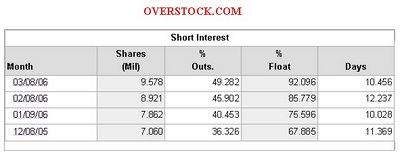
Not very fair is it? Now this situation is with the shares being properly 'borrowed'. I question the validity of being able to borrow a stock to short it they way the market does it, especially considering that the accounts still show the stock as being held by the account even if the shares have been borrow. This would be like letting your friend borrow your car and it still being in your driveway despite the fact that he had driven it to work. (Or how about your car title being transfered to the person borrowing the car while you still have to pay car payments, insurance, etc.)

As mentioned above, shorting a stock has the result of increasing the amount of shares that are available for sale. Maybe this is one reason why they had the up tick test, where you could not short a stock if the previous trade price was lower than the one before that. With that removed, a short seller can sell with a low limit and if the trading is thin watch the price of the stock fall as his short sell order is filled with the available buy orders. So a person who does not even own the stock can negatively effect the price.

A result of short sales is an increase in the supply of shares available to be sold at every price level (up and down) and reducing the pressure on the stock price to rise in order to meet a demand for the shares, even if all the stockholders have no intention of selling, since others are willing to take your shares and sell them (for you.) It is almost if the system is stacked to the side of selling.

Now imagine the increase in the available pool of shares when brokers start selling shares without borrowing them. For example, let’s say that none of a company's stockholders are interested in selling their stock and none are available to borrow to short, but a broker has a client (if not himself) who is just dying to short it. This brings us to the practice/abuse of ‘naked shorting.’
Naked shorting is when a stock is sold short but the ‘borrowed share’ is never delivered three days later at settlement time. Essentially, the broker sold the share without ever buying or borrowing it.

In the U.S., in order to sell stocks short, the seller must arrange for a broker-dealer to confirm that it is able to make delivery of the shorted securities. This is referred to as a "locate", and it is a legal requirement that U.S. regulated broker-dealers not permit their customers to short securities without first obtaining a locate. Brokers have a variety of means to borrow stocks in order to facilitate locates and make good delivery of the shorted security. The vast majority of stocks borrowed by U.S. brokers come from loans made by the leading custody banks and fund management companies (see list below). Sometimes, brokers are able to borrow stocks from their customers who own "long" positions. In these cases, if the customer has fully paid for the long position, the broker can not borrow the security without the express permission of the customer, and the broker must provide the customer with collateral and pay a fee to the customer. In cases where the customer has not fully paid for the long position (meaning, the customer borrowed money from the broker in order to finance the purchase of the security), the broker will not need to inform the customer that the long position is being used to effect delivery of another client's short sale. - Wikipedia
This is not an acceptable way to run a market. Not only that but the “locating” of these shares is deceptive. Take a look at how the regulators define locating stock to short:
Question 4.1: How should broker-dealers determine “reasonableness” to satisfy the locate requirement of Regulation SHO?

Answer: Rule 203(b)(1)(ii) permits a broker or dealer to accept a short sale order in an equity security if the broker-dealer has reasonable grounds to believe that the security can be borrowed so that it can be delivered on the settlement date. “Reasonableness” is determined based on the facts and circumstances of the particular transaction. What is reasonable in one context may not be reasonable in another context. The Commission provided some examples of reasonableness in the Adopting Release. (69 FR at 48014 and Footnotes 58, 61 and 62).
Why on earth is the settlement day for trades still three days later when we have electronic trading? How is it possible for a broker to sell shares of a stock that it does not have, without landing in jail? This is criminal behavior. It only the regulations that permit this sort of behavior.

How is it that a broker is permitted to sell short shares if he has a reasonable certainty that he will be able to locate shares to borrow? How is it that I cannot buy actual shares unless they are sure I have the funds in my account before I even place the order, let alone let me provide funds on the settlement date. (Or simply buy stocks at whatever price without worrying about paying for them!) The rules on shorting should be simple; you cannot short a stock unless you have the borrowed shares in-hand.

Better yet, they should do away with short selling of stock. If you want to sell a stock, you should buy it first!
--------------------
These naked shorting phantom shares will produce a fail to deliver on settlement date of the trade since there were not actual shares behind the trade. It is assumed that when there is a fail to deliver, that it is often a short sale that is involved. However, I would think that just as often it is a person who sold a stock held in a margin account whose shares were borrowed and the broker did not replace them when sold. I wonder how often that is the reason for a fail to deliver?

Previous:
Are Brokers 'Screwing' Stockholders through Short Selling? - 6 Apr 06

--------------------
Add to Google
--------------------

Monday, August 20

"the biggest global margin call in history"

I had written a while back about the dangers of having a margin account. Looking at the last week's activity in the stock market, I know that people were getting burned simply by trading on margin and not being able to survive the market swings. Had I had my investments in a margin account, I would have been forced to sell or my broker surely would have sold due to margin call issues. That would have been unfortunate, since at the opening of the market on Friday, my account had not only gained back the losses, but also triggered a sell order as the stock opened much higher than the day before, closing a successful investment. An investment that was down thousands of dollars only two days earlier. (And the stock is now down $2.50+ from that sell point, simply due to moving with the market .)

NEW YORK - They are dreaded words on Wall Street, and they're becoming more common: margin call.

More money invested in the stock market is borrowed from brokers than ever before, and some investment houses are asking for theirs back through what are known as margin calls. It's one of the reasons why Wall Street has sold off so sharply in recent days.

"It's being referred to as the biggest global margin call in history," said Hugh Johnson, chairman and chief investment officer of Johnson Illington Advisors. A flood of margin calls is typical in a market correction, he said, and "it can turn small declines into large declines. That's why leverage is dangerous." - TBO

For some reason 'investors' only see the benefits of trading on margin, the possibility of increased profits. However, the possibilities also extend to increased losses, up to wiping out your entire investment.

To reinforce my belief that you should not be trading on margin, comes the news that even professionally-managed hedge funds are getting margins calls.

Why is a hedge fund like Global Alpha affected by events in markets far removed from its bread-and-butter exposure? The root of the problem is high leverage. For example, when this debacle hit, one of Goldman's funds was leveraged 6 to 1, so every dollar of investor capital claimed six dollars of positions. This is the dry kindling for a market firestorm. When things go bad for a highly leveraged hedge fund, it gets a margin call and has to sell assets to reduce its exposure. Naturally, as it sells, prices drop. The falling prices mean a further decline in the fund's collateral, forcing yet more selling. And so goes the downward cycle.

Hedge funds that hold the toxic CDOs (collateralized debt obligations) can easily undermine those that don't. It can be difficult to sell the stuff that's causing the problem; those markets are beyond redemption. So if you can't sell what you want to sell, you sell what you can sell. The fund looks at its other holdings, focusing on the more liquid positions and reduces its exposure there. This causes pressure on these markets, markets that have nothing to do with the original problem, other than the fact that they happened to be held by the fund that got in trouble. Now that these markets are feeling the heat, other highly leveraged funds with similar exposure will have to sell. This leads to another cycle of selling, but in what was up to that point a healthy market unrelated to the initial turmoil. - Time

There is an important difference between you and them getting a margin call. They can go and borrow money to pay their margin call. Part of the recent Fed action was loans made for this purpose. You unfortunately, will have to pony up the money yourself, if you have it. Chances are, given the severe declines recently, your broker did not give you time to meet your margin call and sold some/all of your holdings before you could even react.

Margin accounts make you an investing partner with your brokerage. Unfortunately, their goals are not always the same as yours, and that can really cost you.

Feel free to add in the comments your own experience as there is not much information available on what is happening to small investors.

P.S.

One issue that apparently has increased the volatility of the market has been a change in the rule for shorting stocks. Before, to short, you could only do so on an up-tic, meaning that the stock just traded up. That rule is now gone. This now allows brokers to short a stock while it nosedives, adding their shares to the pile of those already looking to sell. As supply increases....

Previous posts:
You should not be trading on Margin - 9 Jan 2006 (READ)

Congress Should Investigate Short Selling Records - 9 June 2006
Are Brokers 'Screwing' Stockholders through Short Selling? - 6 April 2006
Criminal Charges for Hedge Fund Over Naked Shorting - 9 Dec 2006
Morgan Stanley fined $2.9 Million for Rogue Trading - 26 Oct 2006
Do You Know If You Have A Margin Account? - 2 May 2007

Wednesday, May 2

Do You Know If You Have A Margin Account?

This does not surprise me at all:

Investors often don't even know they have a margin account, even though many brokerage firms automatically put investors into margin accounts when they sign up. The incentives are plenty: Not only do brokerages reap interest charges and transaction fees, they also profit by lending shares held in margin accounts to other traders. To avoid getting sucked dry, investors must ask to be put into cash accounts. - Forbes

There is no law against being stupid, but beware since there is no law against taking advantage of your stupidity either. The same is true for being careless with your money as you will quickly find it in the hands of others.

Somewhere in the brokerage account opening package is a clause that approves the opening of a margin account instead of a cash account. (A cash account is one where you pay the full price of the stock at the time you purchase it.) You are expected to read the application. Even if you did not, once the account is open you would see margin data in your portfolio, and eventually being charged for taking advantage of margin the first time you purchased more stock than you had deposited money for. If you don't know if you have a margin account, then you should seriously consider not investing.

So how do different firms present the option of opening a margin account? I went to TD Ameritrade, which I currently use, and checked out the open a new account option. As you can see from the screen shots, TD Ameritrade requires you to request the ability to trade on margin. No trickery here.

TDAmeritrade:


Too bad they are not as upfront with you when it comes to their paper application. It is setup to for you to automatically open a margin account, unless you opt-out.


"All qualified accounts are opened as margin accounts, allowing you to borrow against the value of certain securities"

This is the source of the problem mentioned in the article. By wording it this way, it gives the impression that it is normal to open a margin account. So why would you not open a normal account, right? It seems pretty strange that they would require you to request margin approval when opening the account online, but require you to opt out of a margin account when filling out a paper application. Are they guiding older, less internet savvy, clients to margin accounts? I think TDAmeritrade has some explaining to do here. Not for anything, many people are going to miss the opt-out because they are busy filling out the other info requested in the section. So how about giving those using a paper application the same clear choice that they are given when applying online?

eTrade:
Pretty open and clear application process here. (I did not check their paper application as it is delivered by mail.)


Schwab:
Schwab seems to have the sneakiest application process that I can see, since they pre-select margin trading for your account type, even if you mark on the previous screen that you have low income and have no investment experience. Come on Chuck, how about listening to your new clients who tell you that they have no investment experience. Do you really think putting them in a margin account is the right thing to do? How about putting that in your next commercial?


Good luck finding that account agreement mentioned in the above screenshot as I did not see a clear link to one on their website. Here is one clause that I found interesting from their margin agreement:

We may transfer Securities and Other Property from any brokerage account in which you have an interest to any other brokerage account in which you have an interest, regardless of whether there are other Account Holders on either Account, if we determine that your obligations are not adequately secured or to satisfy a margin deficiency or other obligation. You agree to pay on demand any account deficiencies after liquidation, whether liquidation is complete or partial. - Schwab Margin Agreement extract (4/28/07)

So, if they decide that you are in trouble on your account, they have the right to raid any other account you might have, like your child's account that your a custodian on, or perhaps a parent's account, depending on what 'in which you have an interest' means. Taking money from joint accounts is pretty a pretty low thing to do, even for a brokerage.

Now why does this matter? Take this recent alert from the SEC:

NASD Warns Investors of the Risks Associated with Using Margin to Purchase Securities

Washington, DC — NASD today issued an updated Investor Alert warning investors about the risks associated with trading on margin. Since the release of a previous Alert on this topic in 2003, the amount of debt taken on by investors to buy securities has reached a record high of $321.2 billion in February 2007.

"We are concerned too many investors are unaware they could suffer substantial financial losses by using debt to purchase securities," said Mary L. Schapiro NASD Chairman and CEO. "By updating our Alert on this topic, we hope to remind investors not to underestimate the risks involved."

The Alert, Investing with Borrowed Funds: No "Margin" for Error, explains that investors who cannot satisfy margin calls can have large portions of their accounts liquidated under the market conditions at the time, favorable or unfavorable. That liquidation can result in substantial losses. Some of the risks associated with opening a margin account explained in the Alert are:

* Firms can force the sale of securities in accounts to meet a margin call.
* Firms can sell securities without contacting the account holder.
* Account holders are not entitled to choose which securities or other assets can be sold.

* Firms can increase margin requirements at any time and are not required to provide advance notice.

* Account holders are not entitled to an extension of time on a margin call.
* Account holders can lose more money than is deposited in a margin account.
* Account holders should ask whether they will automatically be placed into a margin account and, if so, what the rate of interest will be and what circumstances would trigger a margin loan.

Along with explaining the risks involved with margin, the Alert provides some basic facts about purchasing securities on margin and where to turn for help. Investors can obtain more information about, and the disciplinary record of, any NASD-registered broker or brokerage firm by using NASD's BrokerCheck. NASD makes BrokerCheck available at no charge. In 2006, members of the public used this service to conduct more than 4.7 million searches for existing brokers or firms and requested more than 207,000 reports in cases where disclosable information existed on a broker or firm. Investors can link directly to BrokerCheck at www.nasd.com/brokercheck. Investors can also access this service by calling (800) 289-9999.

Too many rookies trading on margin result in inflating the stock market like a bubble. The problem with bubbles is that they pop and the more margin accounts that are long in the market, the more dramatic the drops are when the market goes red. When the stock market has a bad day, margin accounts get margin calls. Since many will not have the money to meet a margin call, they will instead sell driving the price of stocks lower. This is combined with brokerages liquidating accounts of those who have not cleared their margin call. Anyway, the price of most stocks fluctuate, and many will fluctuate due to a generally down day, even though there is nothing wrong with the stock itself.

Do you still want that margin account?

I want you to have one. It is those really bad days with lots of margin calls where I pick up some good stock being sold cheap.

Hopefully your not using any margin so you can request to have your account changed to a cash account.

Mad Money Is Piling Into Margin Accounts - Forbes

Other Related:
You should not be trading on Margin - FFI 9 January 2006
Congress Should Investigate Short Selling Records - FFI 9 June 2006

Friday, June 9

Congress Should Investigate Short Selling Records

Congress is eager to investigate all sorts of things these days; Oil companies for gouging, ExxonMobil (XOM) for it’s high profits and the NSA for it’s efforts to catch terrorists.

At the end of the day, they most likely will find no illegal activity and the report investigating alleged gouging has already come out noting that no evidence of gouging was found. I suggest that if Congress is serious about investigating and finding criminal activity, then their chances are much better if they direct their activities to investigate the practice of short selling.

For the longest time a small minority have been on a crusade to get the Government to investigate short sale activity for potential abuses, namely the shorting of stock without actually borrowing the shares they are selling short. So far they have only received minor interest. Now however there are two new groups, one of them getting ready to take their own action; Theses groups are the corporation’s themselves (not just Overstock.com) concerned about rampant over voting and the brokerage’s hedge fund clients, the very clients that do the short selling.

Yes, this is partly about naked short selling. But a recent article by Bloomberg titled “Corporate Voting Charade” documents yet another abuse created by short selling, namely “Naked voting.”

When you purchase stock you also obtain voting rights, normally one vote per share. Shareholders vote on the appointment of directors, vote on shareholder proposals, and vote whether to accept takeover offers as well as countless other issues.

When you purchase stock on margin, your broker has the right to borrow the stock from (under) you and loan it to a short seller. (A short seller sells stock he does not own, betting that he can buy it back later at a cheaper price.) When your stock is borrowed, you lose your voting rights as that right stays with the stock. In addition, you also lose any dividend the stock pays, and instead receive a ‘dividend in kind’ (a payment equal to what you would have received as a dividend but you receive the payment from the short-seller, not the company.) The difference matters because the in-kind dividend payment is taxed at a higher rate.

While brokerages appear to be real good at borrowing stocks, they don’t seem to bother to keep track of the votes, instead sending voting material to all who hold the stock in their accounts according to the Bloomberg article. This can lead to rampant voting fraud as each share can be borrowed multiple times, being held in multiple accounts, but it still is entitled to only one vote. So 100 shares borrowed twice might result in 300+ votes. The Bloomberg article claims that brokerages are doing this on purpose because they do not want their clients to know the negative consequences of having a margin account.

Wall Street securities firms such as Goldman Sachs Group Inc., Merrill Lynch & Co. and Morgan Stanley lend shares from a central pool, and the brokerages don’t attribute loans to the accounts of particular clients. While the small print in a typical brokerage contract says a customer’s voting rights may be affected if the firm loans out stock, most brokerage customers likely don’t even notice when short sellers borrow stock because their accounts typically list the same number of shares as before. “Everybody’s reaction when they find out about this is that they can’t believe it happens,” says Anne Faulk, chairwoman of Swingvote LLC in Atlanta, which manages proxy voting for institutional investors who may own stock in thousands of companies. – Bloomberg ‘Corporate Voting Charade’ (PDF)

I am pretty surprised that they would be so careless with voting rights. Then again, it’s not too surprising, since nobody has bothered to pay attention to this in the past, and only in recent years has short selling become popular and an available trading option to most investors. After all, this is just a small loose end and it really just costs them a little for the extra annual reports. Who were they really hurting anyway? Many small shareholders never even bother to vote. It will be interesting to see if this angle gets any traction. I would think that it would not be too hard for some lawyers to come up with a good lawsuit on behalf of the corporations whose elections have been handed fraudulent votes by the brokerage houses. This must be a crime in some way.

There is another group that is considering legal action, the hedge funds who were paying for borrowed shares that they were shorting, but now believe that the shares were not actually provided at the settlement date, turning their trades into ‘naked’ shorts.

New York - Get your hankies ready: Hedge funds feel they're the newest victims.

A long-simmering issue may soon come to a boil, potentially putting Wall Street's largest firms on the hook for billions more in liabilities years after the research scandal that extracted $1.4 billion in legal fines from ten of the most influential investment banks.

This time, prime brokers face scrutiny for the fees they charge hedge fund clients, with securities lending being a particular focus.

Attorneys at plaintiffs' firm Milberg, Weiss, Bershad & Schulmanare investigating securities lending fees and other practices by the biggest prime brokers and are considering bringing a class-action lawsuit on behalf of hedge funds. - Forbes

I find it somewhat amusing that the group most responsible for the short selling mess is now complaining that the industry practices stink. This also appears to be a tacit admission that naked shorting is a fact and not the fiction Wall Street has been claiming it to be.

Securities lending is among the most lucrative of prime brokerage services to the banks, reaping some $10 billion in annual fees, and the business just keeps growing as more hedge funds pop up. But it is also among the most opaque of businesses, with plenty of opportunity for abuse, lawyers unconnected with the Milberg firm say.

Hedge funds have alleged privately for years that they are being overcharged for prime brokerage services or charged wrongly for services that haven't been performed. Most of the griping has to do with securities loaned but never delivered, the allegation being that the prime brokers are lending securities at high fees without actually having possession of the securities to lend in the first place. - Forbes

This activity might be signaling the end of short selling as a way to make a quick buck. After all, if the hedge funds are going to deliberately bring attention upon themselves (it is the hedge funds that the brokerage houses are doing this for.)

There has also been action by the NASD, which has suspended a broker for naked short trading of his own personal account.

Washington, D.C.— NASD announced today that Steven W. Norin, a broker who is currently registered with Citigroup Global Markets Inc. of New York, has been suspended for 90 days and will pay $400,000 to settle charges that he engaged in a pattern of improper short sales in his personal accounts.

NASD found that from March 2003 through November 2004, Norin executed 100 short sales in 22 different securities and improperly marked them as "long." NASD found that Norin wanted to sell certain securities in his personal accounts short because he believed they were overpriced; when he discovered that there was no available inventory or borrowable stock, he improperly marked the orders long in the firm's order entry system to defeat the system's ability to prevent improper short sales. - NASD

Makes you wonder what kind of accounting the brokerages do considering that he was doing this for over a year. You would think that they would also look at whose trades were resulting in fail to deliver at settlement time. From the looks of it, his employer either did not know what he was up to or knew and did nothing about it. I wonder, which is worse?

Then we have Former Broker John F. Mangan, Jr. who has been barred for Naked shorting:

Washington, D.C. — NASD announced today that John F. Mangan, Jr., a hedge fund manager formerly registered as a broker with Friedman, Billings, Ramsey & Co. (FBR) of Arlington, VA, has been permanently barred from associating with any NASD-registered firm and will pay a $125,000 fine to settle charges that he deceptively obtained shares in a PIPE transaction, improperly sold the shares short, and shared in profits from the shares without obtaining permission from FBR. - NASD

Looking at the NASD site, there is also the following: (Click on the link to read the whole disciplinary action statement for each firm. PDF Format.)

Dynamex Trading, LLC - NASD determined that the firm failed to show the correct execution price on brokerage order memoranda. Moreover, NASD found that the firm’s supervisory system failed to provide for supervision reasonably designed to achieve compliance with applicable securities laws, regulations, and NASD rules concerning trade reporting—Automated Confirmation Transaction Service (ACT) compliance, sales transactions— reporting accurate short sale indicators, and books and records. - May 2006

Merrill Lynch, Pierce, Fenner & Smith, Incorporated - The findings also stated that the firm failed to report the correct symbol indicating whether the firm executed transactions in eligible securities as principal, riskless principal or agent, and failed to report the correct symbol to ACT indicating whether transactions in eligible securities were “buy,” “sell,” “sell short,” “sell short exempt,” or “cross.” - May 2006

Fulcrum Global Partners LLC – The findings also included that the firm effected
short sales in a listed security below the price at which the last sale thereof, regular way, was reported pursuant to an effective transaction reporting plan, and failed to provide written notification disclosing that the transaction was executed at an average price to its customer. - April 2006

Direct Access Brokerage Services, Inc. - NASD found that the firm executed short sale transactions and failed to report them to ACT with a short sale modifier. NASD also found that the firm executed transactions based on a prior reference point in time, and failed to report each of these transactions
to ACT with a prior reference point modifier. - March 2006

Smith, Moore & Co. - Without admitting or denying the allegations, the firm consented to the described sanctions and to the entry of findings that it failed to report its short-interest positions in various securities to NASD. The findings stated that the firm’s supervisory system did not provide for supervision reasonably designed to achieve compliance with respect to the applicable securities laws and regulations concerning short-interest reporting. - March 2006

Prashant Biraj Bhuyan (Registered Representative, New York, New York) submitted a Letter of Acceptance, Waiver and Consent in which he was censured, fined $5,000 and suspended from association with any NASD member in any capacity for six months. In light of Bhuyan’s financial status, the imposed fine is $5,000, and it must be paid before Bhuyan reassociates with any NASD member following the suspension, or before he requests relief from any statutory disqualification. Without admitting or denying the allegations, Bhuyan consented to the described sanctions and to the entry of findings that he executed short sale transactions in a security listed on a national securities exchange at or below the current inside bid when the current inside bid was below the preceding inside bid on the security. The findings also stated that Bhuyan executed short sale orders and failed to properly mark the order tickets for those orders as short. The findings also included that Bhuyan executed short sale orders in a security and, for each order, failed to make an affirmative determination that he would receive delivery of the security on the customer’s behalf or that he could borrow the security on the customer’s behalf for delivery by the settlement date. Bhuyan’s suspension began on March 6, 2006, and will conclude at the close of business on September 5, 2006. - March 2006

Wave Securities, LLC Without admitting or denying the allegations, the firm consented to the described sanctions and to the entry of findings that it did not make and annotate an affirmation determination prior to accepting customer short sale orders; it relied upon a document that did not meet the requirements that any hard to borrow list include securities that are restricted pursuant to Uniform Practice Code Rule 11830, and the creator of the list attest in writing that the NNM or listed security not on the list is easy to borrow or available for borrowing; and the firm did not limit its use of the list to NNM and listed securities. The findings stated that the firm incorrectly classified a hedge fund customer account as a broker-dealer account. NASD found that the firm accepted short sale orders from the hedge fund customer and failed to make/annotate an affirmative determination. In addition, NASD found that the firm’s supervisory system did not provide for supervision reasonably designed to achieve compliance with respect to marking customer order tickets, bid test, prompt receipt and delivery of securities and ACT reporting. - February 2006

Ryan & Company, LP and Scott William Ryan submitted an Offer of Settlement in which Ryan was barred from association with any NASD member firm in any capacity, and the firm was expelled from NASD membership. Without admitting or denying the allegations, they consented to the described sanctions and to the entry of findings that they engaged in a scheme to create and maintain short positions in Over-the-Counter (OTC) equity securities on behalf of the firm’s client hedge funds, in that they willfully and intentionally effected short sale transactions. The findings stated that the firm failed to report option positions to NASD, and failed to report transactions and reported incorrect information to the Automated Confirmation Transaction ServiceSM (ACTSM). In addition, NASD found that the firm reported non-bona fide wash sale transactions to ACT, and failed to provide for supervision reasonably designed to detect and prevent NASD rule violations.

Are there going to be more cases like this? I am pretty sure there will be. Time will tell.

A Review of Current Securities Issues - US Senate
Corporate Voting Charade (PDF Format, but an excellent read) Bloomberg Markets
Hedge Funds: Got Kleenex? - Forbes
The Stock Market is Patently Unfair - The Street
NASD Suspends Broker for 90 Days - NASD

Monday, January 9

You should not be trading on Margin

Trading on margin is supposed to be a way to multiply your buying power. Instead of paying the full cost of the stock, you borrow a portion of the funds needed from your stockbroker and then use the stock as collateral on the loan.

If the price of the stock goes up you get to keep all of the profit when you sell the stock, merely repaying the amount borrowed plus interest and fees. The problem comes when the price of the stock goes down. If you sell the stock at a loss, you keep whatever is left after repaying the loan plus interest. It is possible to lose all of your money and still owe the broker additional funds.

The price of stocks fluctuate which is not normally a problem if you are intending on holding the stock for a while. However, when you buy stock on margin, you need to maintain your margin maintenance requirement. If the price of the stock goes down too much, then you will receive a margin call. This is a demand for you to add more money into your account to protect the amount loaned from the broker. Call it the broker’s safety buffer.

If you do not have additional funds to add to your account, then you’ll have to sell the stock at a loss. If the price of the stock drops dramatically, then the broker might sell the stock without prior notification to you, as there is no requirement that they contact you before selling the stock from under you. Of course this always happens at the point of greatest loss.

Even if you get a margin call, and you are sure that the drop in the price of the stock is only temporary, chances are, you are not going to have the additional funds needed to meet your margin call. If you are lucky, this is the point that you are buying on margin. You are not likely to ever be that lucky.

But who am I for you to take advice from? I am certainly neither a professional nor even a person in ‘the know.’ However, I just came to conclusion that persons buying stock on margin is one reason for some of the illogical movements seen recently in the stock exchange. There is no need to heed my warnings. Instead take a look at the warning from the Security and Exchange Commission, the SEC:

Recognize the Risks
Margin accounts can be very risky and they are not suitable for everyone. Before opening a margin account, you should fully understand that:

  1. You can lose more money than you have invested;

  2. You may have to deposit additional cash or securities in your account on short notice to cover market losses;

  3. You may be forced to sell some or all of your securities when falling stock prices reduce the value of your securities; and

  4. Your brokerage firm may sell some or all of your securities without consulting you to pay off the loan it made to you.

You can protect yourself by knowing how a margin account works and what happens if the price of the stock purchased on margin declines. Know that your firm charges you interest for borrowing money and how that will affect the total return on your investments. Be sure to ask your broker whether it makes sense for you to trade on margin in light of your financial resources, investment objectives, and tolerance for risk.

Be sure not to overlook this warning:


Understand Margin Calls – You Can Lose Your Money Fast and With No Notice
If your account falls below the firm's maintenance requirement, your firm generally will make a margin call to ask you to deposit more cash or securities into your account. If you are unable to meet the margin call, your firm will sell your securities to increase the equity in your account up to or above the firm's maintenance requirement.

Always remember that your broker may not be required to make a margin call or otherwise tell you that your account has fallen below the firm's maintenance requirement. Your broker may be able to sell your securities at any time without consulting you first. Under most margin agreements, even if your firm offers to give you time to increase the equity in your account, it can sell your securities without waiting for you to meet the margin call.

If this is not warning enough for you, how about taking a look about what the NASD has to say about margin. Just look at the title of the Investor Alert posted about margin:

“Investing with Borrowed Funds: No "Margin" for Error.” - NASD

The Alert mentions a number of issues, including:

There are a number of risks that you need to consider in deciding to trade securities on margin. These include:

  1. Your firm can force the sale of securities in your accounts to meet a margin call. If the equity in your account falls below the maintenance margin requirements under the law—or the firm's higher "house" requirements—your firm can sell the securities in your accounts to cover the margin deficiency. You will also be responsible for any short fall in the accounts after such a sale.

  2. Your firm can sell your securities without contacting you. Some investors mistakenly believe that a firm must contact them first for a margin call to be valid. This is not the case. Most firms will attempt to notify their customers of margin calls, but they are not required to do so. Even if you're contacted and provided with a specific date to meet a margin call, your firm may decide to sell some or all of your securities before that date without any further notice to you. For example, your firm may take this action because the market value of your securities has continued to decline in value.

  3. You are not entitled to choose which securities or other assets in your accounts are sold. There is no provision in the margin rules that gives you the right to control liquidation decisions. Your firm may decide to sell any of the securities that are collateral for your margin loan to protect its interests.

  4. Your firm can increase its "house" maintenance requirements at any time and is not required to provide you with advance notice. These changes in firm policy often take effect immediately and may cause a house call. If you don't satisfy this call, your firm may liquidate or sell securities in your accounts.

  5. You are not entitled to an extension of time on a margin call. While an extension of time to meet a margin call may be available to you under certain conditions, you do not have a right to the extension.

  6. You can lose more money than you deposit in a margin account. A decline in the value of the securities you purchased on margin may require you to provide additional money to your firm to avoid the forced sale of those securities or other securities in your accounts.
No shortage of risks to be sure. However, look who’s not risking anything:


Margin Loans: Who's Profiting?
Margin loans can be highly profitable for your brokerage firm. They may also be highly profitable for your broker. Your broker may receive fees based on the amount of your margin loans. This may take the form of a percentage of the interest you pay on an ongoing basis. - NASD

The more people trading a stock on margin, the more likely the stock will suffer a greater drop in the price of a stock after an initial price drop due to many margin holders being forced to sell as they cannot meet the margin call. Brokers might even increase the selling pressure by closing margin positions with market sell orders exposing even more accounts to margin calls. At a minimum, the stock is not rising to your sell point, so you continue to hold it, all the time accruing margin fees from your broker.

To receive a margin call a stock only needs to make one trade at a price below your margin requirement. So even if the price of the stock recovers during the day, you may still have to pay into your account. This might explain the sharp drop in a stock’s price when it manages to meet expectations. Brokers might try to trigger as many margin calls as possible, in addition to triggering as many stop-loss orders as possible. A stop-loss order is when the price of the stock goes below a certain level, this then triggers your stop loss order to sell the stock at market.

Buying even good stocks on margin can be risky as sometimes the entire market moves down on disappointing news that is not related at all to the stock itself. Take poor results from a top corporation in the same sector as a stock that you own on margin. This might result in an unplanned margin call for you.

Information concerning trading on margin often caries a warning that margin is for experienced traders only. I consider myself an experienced trader and I know that I do not have the discipline to avoid a margin call and I never have additional funds that I don’t already have a purpose for. If I was trading on margin and received a margin call, I would be forced to sell. Thankfully I have a cash account and while my stomach turns inside out sometimes on red market days, I am often confident enough in what I own to hold for a better day to sell, most times for a profit.

Also:
If you buy stock on margin, your broker most likely has the right to loan out your shares to a short-seller. This has two main effects. First, they help to limit any pressure to increase the price of the stock by increasing the supply and essentially allowing your shares to be bought twice, once by you, and then again when the short seller sells them. If this happens to your shares, you might suffer the second effect, you don’t receive any dividend that the stock might payout. You will receive a payment from the short-seller for the amount of the dividend, but that will be taxed at a different rate as the payment was not a dividend. (More on short selling in a future post.)

Note: This post mentions that brokers “might” do some nasty things to manipulate the market. Of course I did not mean you, after all, that would be illegal.

Margin:
Borrowing Money To Pay for Stocks – US SEC
Investing with Borrowed Funds: No "Margin" for Error - NASD

Dividends:
Dividend Tax Breaks at Risk – Fool.com
Dividends on Stock in Margin Accounts May Not Be Eligible for Reduced Tax Rate – Morgan Keegan

Thanks to all who thought that this post was worth mentioning in their blogs:

And also Searchlight Crusade.

Thanks all!