Showing posts with label Naked shorting. Show all posts

Wednesday, January 7

Short Selling Harms Company Stockholders (Illustrated)

The Wall Street consensus is that the practice of short selling is an accepted market strategy.
In finance, short selling or "shorting" is the practice of selling a financial instrument that the seller does not own at the time of the sale. Short selling is done with intent of later purchasing the financial instrument at a lower price. Short-sellers attempt to profit from an expected decline in the price of a financial instrument. Short selling or "going short" is contrasted with the more conventional practice of "going long" which occurs when an investment is purchased with the expectation that its price will rise.

Typically, the short-seller will "borrow" or "rent" the securities to be sold, and later repurchase identical securities for return to the lender. If the security price falls as expected, the short-seller profits from having sold the borrowed securities for more than he later pays for them but if the security price rises, the short seller loses by having to pay more for them than the price at which he sold them. The practice is risky in that prices may rise indefinitely, even beyond the net worth of the short seller. The act of repurchasing is known as "closing" a position. Short Selling is often used in hedge funds. - Wikipedia
We all know this. But did you ever think that shares could be borrowed multiple times? Well they can.


Imagine a company that has ten shares of stock. I own five of the shares and you own five. Your shares are borrowed by a broker who then re-sells them. The end result, I own five shares, you own five shares, buyer ‘x’ owns five shares. That totals fifteen shares. Short Selling has the effect of increasing the total number of shares available for a corporation well above the total number of authorized shares. The way the professionals on Wall Street reason that this is OK is because somewhere there is shorter ‘y’ who owes those fives shares and is expected to buy them at some point in the future. (And yet, the market regulators only publish that number owed once a month instead of daily like other market trading statistics.)

In this basic example above, the total number of shares available was increased by 50%.
However, there are plenty of stocks with five and even ten percent of the stock ‘float’ shorted. That increases the number of shares available by millions. The only group that should have the right to increase the authorized share capital of a corporation are the owners themselves. Think 50% is an unrealistic number? Take my post from April, 2006 (Are Brokers 'Screwing' Stockholders through Short Selling?) which covered the extreme case of OVERSTOCK.com where :
Overstock.com has issued about 19 million shares of stock. The latest short interest figures from the stock market have about 9.5 million shares short, about 49% of the total. This number is even more impressive when you figure that not all 19 million shares are available for shorting. According to Overstock, there are only 8,970,394 (10 March) registered in the electronic exchange, so that would be the theoretical maximum available to short. The reminder of Overstocks stock either has been issued as paper certificates, and not eligible for shorting unless a broker borrows them and adds them into the electronic register, or the shares have not been issued in any form by the Company.
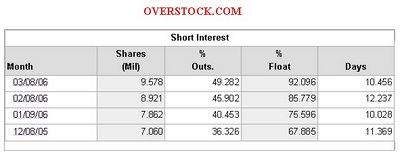
Not very fair is it? Now this situation is with the shares being properly 'borrowed'. I question the validity of being able to borrow a stock to short it they way the market does it, especially considering that the accounts still show the stock as being held by the account even if the shares have been borrow. This would be like letting your friend borrow your car and it still being in your driveway despite the fact that he had driven it to work. (Or how about your car title being transfered to the person borrowing the car while you still have to pay car payments, insurance, etc.)

As mentioned above, shorting a stock has the result of increasing the amount of shares that are available for sale. Maybe this is one reason why they had the up tick test, where you could not short a stock if the previous trade price was lower than the one before that. With that removed, a short seller can sell with a low limit and if the trading is thin watch the price of the stock fall as his short sell order is filled with the available buy orders. So a person who does not even own the stock can negatively effect the price.

A result of short sales is an increase in the supply of shares available to be sold at every price level (up and down) and reducing the pressure on the stock price to rise in order to meet a demand for the shares, even if all the stockholders have no intention of selling, since others are willing to take your shares and sell them (for you.) It is almost if the system is stacked to the side of selling.

Now imagine the increase in the available pool of shares when brokers start selling shares without borrowing them. For example, let’s say that none of a company's stockholders are interested in selling their stock and none are available to borrow to short, but a broker has a client (if not himself) who is just dying to short it. This brings us to the practice/abuse of ‘naked shorting.’
Naked shorting is when a stock is sold short but the ‘borrowed share’ is never delivered three days later at settlement time. Essentially, the broker sold the share without ever buying or borrowing it.

In the U.S., in order to sell stocks short, the seller must arrange for a broker-dealer to confirm that it is able to make delivery of the shorted securities. This is referred to as a "locate", and it is a legal requirement that U.S. regulated broker-dealers not permit their customers to short securities without first obtaining a locate. Brokers have a variety of means to borrow stocks in order to facilitate locates and make good delivery of the shorted security. The vast majority of stocks borrowed by U.S. brokers come from loans made by the leading custody banks and fund management companies (see list below). Sometimes, brokers are able to borrow stocks from their customers who own "long" positions. In these cases, if the customer has fully paid for the long position, the broker can not borrow the security without the express permission of the customer, and the broker must provide the customer with collateral and pay a fee to the customer. In cases where the customer has not fully paid for the long position (meaning, the customer borrowed money from the broker in order to finance the purchase of the security), the broker will not need to inform the customer that the long position is being used to effect delivery of another client's short sale. - Wikipedia
This is not an acceptable way to run a market. Not only that but the “locating” of these shares is deceptive. Take a look at how the regulators define locating stock to short:
Question 4.1: How should broker-dealers determine “reasonableness” to satisfy the locate requirement of Regulation SHO?

Answer: Rule 203(b)(1)(ii) permits a broker or dealer to accept a short sale order in an equity security if the broker-dealer has reasonable grounds to believe that the security can be borrowed so that it can be delivered on the settlement date. “Reasonableness” is determined based on the facts and circumstances of the particular transaction. What is reasonable in one context may not be reasonable in another context. The Commission provided some examples of reasonableness in the Adopting Release. (69 FR at 48014 and Footnotes 58, 61 and 62).
Why on earth is the settlement day for trades still three days later when we have electronic trading? How is it possible for a broker to sell shares of a stock that it does not have, without landing in jail? This is criminal behavior. It only the regulations that permit this sort of behavior.

How is it that a broker is permitted to sell short shares if he has a reasonable certainty that he will be able to locate shares to borrow? How is it that I cannot buy actual shares unless they are sure I have the funds in my account before I even place the order, let alone let me provide funds on the settlement date. (Or simply buy stocks at whatever price without worrying about paying for them!) The rules on shorting should be simple; you cannot short a stock unless you have the borrowed shares in-hand.

Better yet, they should do away with short selling of stock. If you want to sell a stock, you should buy it first!
--------------------
These naked shorting phantom shares will produce a fail to deliver on settlement date of the trade since there were not actual shares behind the trade. It is assumed that when there is a fail to deliver, that it is often a short sale that is involved. However, I would think that just as often it is a person who sold a stock held in a margin account whose shares were borrowed and the broker did not replace them when sold. I wonder how often that is the reason for a fail to deliver?

Previous:
Are Brokers 'Screwing' Stockholders through Short Selling? - 6 Apr 06

--------------------
Add to Google
--------------------

Thursday, July 17

Now the US Government Has A Problem With Short Sales?!?!?!

It is funny how all of a sudden the US Government takes an interest in something once it becomes liable for the cost.

Takes this news item:

US regulators will take emergency action to stop abusive short-selling in shares of financial institutions such as mortgage financiers Fannie Mae, Freddie Mac and Lehman Brothers.

Christopher Cox, Securities and Exchange Commission chairman, told legislators yesterday that the agency would issue an emergency rule to stop so-called "naked" short-selling of shares in significant financial entities. The SEC will also consider new rules to extend those trading limits to the rest of the market.

In "naked" short-selling, traders aim to profit from selling shares they do not own and have not borrowed. The emergency rule would require any person making a short sale to borrow the securities before the short sale is effected and deliver the securities on the settlement date. - FT.com
So now that the US Treasury might be dealing with the collapse of Fannie Mae and Freddie Mac stock, they have a problem with short sales of stock, especially in cases of naked shorting. Keep in mind that up to this point the Government and stock market regulators have basically dismissed ALL complaints about stock market short sale abuses.  But now, not only do they appear to admit that there is substantial naked shorting, but that there is also 'abusive' naking shorting as well.

Still, this is pretty damn short sided since it only applies to certain large companies specifically named in the order. I guess it is still ok to abusively short other stocks.  This limited order might oddly push abusive short sellers to other stocks increasing the effect on them of this abusive practice. Lets forget naked shorting for a minute and just concentrate on the shorting of stock.

A person ‘shorts’ a stock by borrowing it and then selling it. He then hopes to make a profit by buying the stock back at a lower price. Short selling is normally defined as an ‘accepted’ practice in the Stock Market.

Short selling:
An investor who sells stock short borrows shares from a brokerage house and sells them to another buyer. Proceeds from the sale go into the shorter's account. He must buy those shares back (cover) at some point in time and return them to the lender.
Shorting has the effect of increasing the total number of shares available. Imagine a company that has ten shares of stock. I own five of the shares and you own five. Your shares are borrowed by a broker who then sells them. The end result, I own five shares, you own five shares, buyer ‘x’ owns five shares. That totals fifteen shares. The way the professionals reason that this is ok is because somewhere there is shorter ‘y’ who owes fives shares. In this basic example, the total number of shares available was increased by 50%. However, there are plenty of stocks with five and even ten percent of the stock ‘float’ shorted. That increases the number of shares available by millions.

Not very fair is it?  Now this situation is with the shares being properly 'borrowed'.  I question the validity of being able to short a stock. Unfortunately for stockholders, shorting a stock has the result of increasing the amount of shares that are available for sale.

A result of short sales is an increase in the supply of shares available to be sold at every price level and reducing the pressure on the stock price to rise in order to meet a demand for the shares, even if all the stockholders have no intention of selling, since others are willing to take your shares and sell them (for you.) It is almost if the system is stacked to the side of selling.


Now imagine the increase in the available pool of shares when brokers start naked selling them.

Let’s say that none of a company's stockholders are interested in selling their stock and none are available to borrow to short, but a broker has a client (if not himself) who is just dying to short it. This brings us to the practice/abuse of ‘naked shorting.’

Naked shorting is when a stock is sold short but the ‘borrowed share’ is never delivered three days later at settlement time. Essentially, the broker sold the share without ever buying or borrowing it.

In the U.S., in order to sell stocks short, the seller must arrange for a broker-dealer to confirm that it is able to make delivery of the shorted securities. This is referred to as a "locate", and it is a legal requirement that U.S. regulated broker-dealers not permit their customers to short securities without first obtaining a locate. Brokers have a variety of means to borrow stocks in order to facilitate locates and make good delivery of the shorted security. The vast majority of stocks borrowed by U.S. brokers come from loans made by the leading custody banks and fund management companies (see list below). Sometimes, brokers are able to borrow stocks from their customers who own "long" positions. In these cases, if the customer has fully paid for the long position, the broker can not borrow the security without the express permission of the customer, and the broker must provide the customer with collateral and pay a fee to the customer. In cases where the customer has not fully paid for the long position (meaning, the customer borrowed money from the broker in order to finance the purchase of the security), the broker will not need to inform the customer that the long position is being used to effect delivery of another client's short sale. - Wikipedia
This is not an acceptable way to run a market. Not only that but the “locating” of these shares is deceptive. Take a look at how the regulators define locating stock to short:
Question 4.1: How should broker-dealers determine “reasonableness” to satisfy the locate requirement of Regulation SHO?

Answer: Rule 203(b)(1)(ii) permits a broker or dealer to accept a short sale order in an equity security if the broker-dealer has reasonable grounds to believe that the security can be borrowed so that it can be delivered on the settlement date. “Reasonableness” is determined based on the facts and circumstances of the particular transaction. What is reasonable in one context may not be reasonable in another context. The Commission provided some examples of reasonableness in the Adopting Release. (69 FR at 48014 and Footnotes 58, 61 and 62).
Why on earth is the settlement day for trades still three days later when we have electronic trading? How is it possible for a broker to sell shares of a stock that it does not have, without landing in jail? This is criminal behavior.  It only the regulations that permit this sort of behavior. How is it that a broker is permitted to sell short shares if he has a reasonable certainty that he will be able to locate shares to borrow? How is it that I cannot buy actual shares unless they are sure I have the funds in my account before I even place the order, let alone let me provide funds on the settlement date. The rule should be simple; you cannot short a stock unless you have the borrowed shares in-hand.

Better yet, they should do away with short selling of stock.  If you want to sell a stock, you should buy it first!

Previous Related Posts:
"the biggest global margin call in history"20 Aug 07
You should not be trading on Margin - 9 Jan 2006 (READ)
Congress Should Investigate Short Selling Records - 9 June 2006
Are Brokers 'Screwing' Stockholders through Short Selling? - 6 April 2006
Criminal Charges for Hedge Fund Over Naked Shorting - 9 Dec 2006
Morgan Stanley fined $2.9 Million for Rogue Trading - 26 Oct 2006
Do You Know If You Have A Margin Account? - 2 May 2007


**********

Saturday, December 9

Criminal Charges for Hedge Fund Over Naked Shorting

Don't tell me that naked shorting does not exist. Don't tell me that it is not a problem either.

When you review SEC action again brokerages, in most cases the firms agree to pay a fine but do not admit any guilt in any wrongdoing. In some cases the firms even lose their license to continue trading, in effect, removing their direct access to the stock market. This type of oversight has been criticized as a failure by the SEC to police brokerages.

However, one of the hedge funds was so brazen in it's naked shorting that even the SEC cannot ignore their illegal activity and appears ready to bring criminal charges against the firm.
Sandell Asset Management is the mystery hedge fund that securities regulators claim tried to cash in on Hurricane Katrina.

The Securities and Exchange Commission last week formally notified the New York-based fund, which has more than $4 billion under management, that it could face a civil fraud action, sources say.

The potential regulatory charges arise from some short sales Sandell made in shares of Hibernia just before it was acquired late last year by Capital One.

A spokesman for the hedge fund, which recently sent a letter to its investors alerting them to the possible action, declined to comment.

Last month TheStreet.com first reported that the SEC was investigating an unidentified hedge fund for supposedly making improper short sales just as Katrina was laying waste to the bank's hometown. Regulators believed the hedge fund sought to profit from Wall Street speculation that the storm devastation would force Capital One to cut the price of its planned acquisition of Hibernia -- as it later did. - The Street
So why is this case so different? For one, it is hard to short a stock when there is clear documentation that there were few shares available to short.
When the hedge fund tried to short shares of Hibernia, it likely had difficulty finding a broker from whom it could borrow shares. That's because so much of the stock had been taken out circulation in anticipation of the deal with Capital One closing as intended on Sept. 1.

In mergers, shareholders of the company being acquired must "tender" their shares to their broker in order to collect on the payout. When the shares are tendered, they generally can't be lent out by brokers to short-sellers who bet against stocks.

A trader with another hedge fund said it too had been thinking about shorting shares of Hibernia after Katrina hit. But it couldn't find a broker that had shares to lend out, so it passed on the trade.

Yet sources say Sandell went ahead and shorted Hibernia anyway. The fund allegedly told brokers at several big Wall Street firms that it was borrowing shares from another brokerage and the big Wall Street firms executed the trades. - The Street
This puts the SEC in a difficult position. If they press the case and prosecute, it will further fuel the claims by those who claim that naked shorting is a problem. Looking at the NASD's own monthly Disciplinary Action Reports, I would have to agree with them that it is a problem. If they don't nail this fund to the wall for naked shorting, then that will be further evidence that the SEC is ignoring the problem.

Keep in mind that most traders like you and I can't get away with shorting improperly if you can manage to short a stock at all. That is because we trade online and have to clearly identify our trades as a short sale. The online trading programs will not let you sell any stock you want without having it in your portfolio. However, brokerages are getting in trouble time and time again for failing to mark sells as 'short Sales'. So they are either modifying your trade before it is executed, because they don't have the shares to loan, but do not want to lose your trade, or it is their traders who are regularly abusing the ability to sell shares short.

Why is it that the brokers who execute short trades be required to have the shares they are borrowing 'in-hand'?

Previous:
Morgan Stanley fined $2.9 Million for Rogue Trading - 26 October 2006
Congress Should Investigate Short Selling Records - 9 June 2006
Are Brokers 'Screwing' Stockholders through Short Selling? - 6 April 2006


Sandell Under Shorting Scrutiny - The Street.com 1 Nov 06
Thomas Sandell's Execution Problem - The Street.com 3 Nov 06

'Failed To Deliver' Shares A Persistent Issue - Investors.com
Not All Shares Deliver - Investors.com
Overstock Short Interest Now 107% of Float on Deposit at DTCC – Overstock
Regulation SHO Threshold Security List - NASDAQ
Dividend Tax Breaks at Risk – Fool.com
A Review of Current Securities Issues - US Senate
Corporate Voting Charade (PDF Format, but an excellent read) Bloomberg Markets
Hedge Funds: Got Kleenex? - Forbes
The Stock Market is Patently Unfair - The Street
NASD Suspends Broker for 90 Days - NASD
NASD NTM Disciplinary Actions Report for October - NASD (PDF)
Monthly Disciplinary Actions 2006 - NASD

Thursday, October 26

Morgan Stanley fined $2.9 Million for Rogue Trading

The 'naked short' issue has been simmering for a long time, so far without getting any real traction. However, there is a steady stream of regulatory fines coming out of the NASD for improper short sale trading. I have covered this in the past, but most of those caught had been smaller traders. Now a big fish has been caught. Take this from the NASD NTM Disciplinary Actions Report for October:

NASD Fines Morgan Stanley Firms $2.9 Million for Widespread Violations of NASD Rules

Number and Scope of Violations Indicate Extensive Reporting Problems at Both Firms NASD imposed fines totaling $2.9 million against Morgan Stanley & Co., Inc. (MSCO) and Morgan Stanley DW Inc. (MSDW) for extensive violations dealing with reporting obligations, best execution, short sales and a range of other NASD, Securities and Exchange Commission (SEC) and Municipal Securities Rulemaking Board (MSRB) rules.

NASD found that MSCO:

  • failed to timely report or incorrectly reported thousands of transactions through the NASDAQ Market Center in NASDAQ National Market securities, OTC Equity securities and listed securities;
  • executed thousands of short sales transactions without ensuring that the firm could deliver or arrange to borrow the securities by the settlement date;
  • failed to execute hundreds of customer trades at the best available price, and will make nearly $5,000 in restitution payments to affected customers;
  • failed to report or incorrectly reported thousands of transactions in corporate bonds; and
  • created locked and crossed market conditions in hundreds of instances.

    NASD found that MSDW:
  • failed to send, or failed to send in a timely manner, required documents to hundreds of customers in connection with municipal bond transactions;
  • failed to report or incorrectly reported thousands of transactions in corporate and municipal bonds; and
  • failed to enforce the firm’s written supervisory procedures with respect to municipal bonds.

    In settling these matters, MSCO and MSDW neither admitted nor denied the charges, but consented to the entry of NASD’s findings. - NASD (PDF. Click for full report)
  • While the full NASD report mentions nothing about 'rogue trading' it was the first thought that popped into my mind reading the report. That these guys were doing whatever with no fear of getting caught. Even though they have been caught (you don't pay a $3 million in fines if your not guilty) I see no mention of this in Google News and only a couple of websites picked up the story at all. This is not the first time they have been fined, and this happens to be one of the smallers fines that they have received lately. Here is a summery of other legal action that Morgan Stanley has been on the receiving end of:

    The NASD fine comes just a few months after the SEC settled charges against the firm for lacking adequate procedures to prevent the misuse of non-public information. Morgan Stanley agreed to a censure and a $10 million fine in June as part of that settlement. In May, the Commission hit the firm with $15 million in civil penalties to settle charges that it destroyed and failed to produce tens of thousands of emails from a previous investigation. - CCH Wall Street

    With all of this money flying out the door in fines, it makes you wonder just how much they are ripping their customers off to still be making a profit?

    Previous:
    Congress Should Investigate Short Selling Records - 9 June 2006
    Are Brokers 'Screwing' Stockholders through Short Selling? - 6 April 2006

    Links:
    NASD NTM Disciplinary Actions Report for October - NASD (PDF)
    Monthly Disciplinary Actions 2006 - NASD

    Thursday, April 6

    Are Brokers 'Screwing' Stockholders through Short Selling?

    A person ‘shorts’ a stock by borrowing it and then selling it. He then hopes to make a profit by buying the stock back at a lower price. Short selling is normally defined as an ‘accepted’ practice in the Stock Market.

    Short selling:

    An investor who sells stock short borrows shares from a brokerage house and sells them to another buyer. Proceeds from the sale go into the shorter's account. He must buy those shares back (cover) at some point in time and return them to the lender.

    Shorting has the effect of increasing the total number of shares available. Imagine a company that has ten shares of stock. I own five of the shares and you own five. Your shares are borrowed by a broker who then sells them. The end result, I own five shares, you own five shares, buyer ‘x’ owns five shares. That totals fifteen shares. The way the professionals reason that this is ok is because somewhere there is shorter ‘y’ who owes fives shares. In this basic example, the total number of shares available was increased by 50%. However, there are plenty of stocks with 5 and even ten percent of the stock ‘float’ shorted. That increases the number of shares available by millions. Some stocks like Overstock.com (OSTK) have more shares sold short than there are real shares registered ‘in the system’ to borrow for shorting. We’ll get back to how that can happen further down in the article. (Think naked shorting)

    I question the validity of being able to short a stock. Unfortunately for stockholders, shorting a stock has the result of increasing the amount of shares that are available for sale.

    A result of short sales is an increase in the supply of shares available to be sold at every price level and reducing the pressure on the stock price to rise in order to meet a demand for the shares, even if all the stockholders have no intention of selling, since others are willing to take your shares and sell them (for you.) It is almost if the system is stacked to the side of selling.

    Of course shorting a stock can backfire on the short seller. If a stock has a high ‘short interest’ and the days to cover is high, then the stock might be at risk for a Short squeeze. As the price of the stock rises, an increasing number of shares that were short are being bought back in order for the short sellers to cover and close their positions, pushing the share price higher. After all, increasing stock prices result in increasing losses for stock shorters. However, all the time that the stock is rising, others are busy attempting to short it with the expectation that the price rise is only temporary.

    You might ask why would a stockholder agree to loaning their shares to another person who is going to turn around and sell them? Sounds pretty counter productive right? It’s not like your getting reimbursed by the trader who’s going to borrow your shares and sell them. Not only do you agree to loan your shares, but you also agree to give up any dividend the stock pays. You still get the amount you would have received as a dividend. However, the money is paid by the person who borrowed your shares, and it is not considered a dividend. It is “in-lieu” income. The person who purchased your borrowed shares receives the dividend. No difference right? Wrong. Dividend income is taxed currently at 15%. In-lieu income is taxed as regular income. After all, the company pays each share a dividend once and the dividend goes to the ultimate holder of the share. So holding dividend paying stocks in a margin account might actually affect you negatively. Of course you can afford more shares if you purchase them on margin, so you might come out ahead anyway. (More on margin accounts in this POST.)

    Do you think that you are not loaning your shares out to a short seller? As it so happens, you agree to loan your shares to your broker for shorting when you open a margin account. So if you have stock in a margin account, chances are that your broker is looking at them as a potential source of shares to make a short sale.

    Let’s say that none of the stockholders is interested in selling the stock, but the broker has a client (if not himself) who is just dying to short it. Which brings us to the practice/abuse of ‘naked shorting.’

    Naked shorting is when a stock is sold short but the ‘borrowed share’ is never delivered three days later at settlement time. Essentially, the broker sold the share without ever buying or borrowing it.

    In the U.S., in order to sell stocks short, the seller must arrange for a broker-dealer to confirm that it is able to make delivery of the shorted securities. This is referred to as a "locate", and it is a legal requirement that U.S. regulated broker-dealers not permit their customers to short securities without first obtaining a locate. Brokers have a variety of means to borrow stocks in order to facilitate locates and make good delivery of the shorted security. The vast majority of stocks borrowed by U.S. brokers come from loans made by the leading custody banks and fund management companies (see list below). Sometimes, brokers are able to borrow stocks from their customers who own "long" positions. In these cases, if the customer has fully paid for the long position, the broker can not borrow the security without the express permission of the customer, and the broker must provide the customer with collateral and pay a fee to the customer. In cases where the customer has not fully paid for the long position (meaning, the customer borrowed money from the broker in order to finance the purchase of the security), the broker will not need to inform the customer that the long position is being used to effect delivery of another client's short sale. - Wikipedia

    This is not an acceptable way to run a market. Not only that but the “locating” of these shares is deceptive. Take a look at how the regulators define locating stock to short:

    Question 4.1: How should broker-dealers determine “reasonableness” to satisfy the locate requirement of Regulation SHO?

    Answer: Rule 203(b)(1)(ii) permits a broker or dealer to accept a short sale order in an equity security if the broker-dealer has reasonable grounds to believe that the security can be borrowed so that it can be delivered on the settlement date. “Reasonableness” is determined based on the facts and circumstances of the particular transaction. What is reasonable in one context may not be reasonable in another context. The Commission provided some examples of reasonableness in the Adopting Release. (69 FR at 48014 and Footnotes 58, 61 and 62).

    Why on earth is the settlement day for trades still three days later when we have electronic trading? How is it possible for a broker to sell shares of a stock that it does not have, without landing in jail? This is criminal behavior. How is it that a broker is permitted to sell short shares if he has a reasonable certainty that he will be able to locate shares to borrow? How is it that I cannot buy actual shares unless they are sure I have the funds in my account before I even place the order, let alone let me provide funds on the settlement date. The rule should be simple; you cannot short a stock unless you have the borrowed shares in-hand.

    Think these cases of failure to deliver are isolated incidents? Guess again. The exchange has to maintain a list of the stocks that have a high rate of ‘failure to deliver’ at settlement date. As of 4 April, Nasdaq had 218 stocks with a high ‘failure to Deliver’. Look at the current list here. Not surprisingly, our friend Overstock.com is on this list. The joke is, it has been on this list for a long while

    As you can imagine, Overstock is not too please about this situation. Who would be happy about someone selling fake shares in their company. They however are trying to do something about it, and have filed suit. Take this point from their site:

    How do you know failures to deliver are occurring and that Overstock's stock is being naked shorted?

    Both the NYSE and NASDAQ say that it is. The SEC now requires the NYSE and NASDAQ to publish a list, updated daily, of companies whose stocks have unusually high volumes of trades that fail to deliver. The list is called the Reg SHO Threshold list, and under Reg SHO, no company should be on the list for more than 13 days: Overstock has been on the list for more than 200 days.

    NASDAQ Reg SHO Threshold Security List.

    NYSE Reg SHO Threshold Security List.

    There are other indications as well. Recently, Overstock's president, Patrick Byrne, and its Chairman, Jack Byrne, each purchased several thousand shares of Overstock, but their brokers could not settle the trades over several weeks.

    Could not settle the trades for weeks? You would think that the broker knew who his clients were. With that in mind, you would think that these trades would not have been screwed up.

    How big of a problem is naked short selling?
    We don't know - the SEC, NASDAQ, and the DTCC all refuse to disclose the daily volume of failures to delver in Overstock's stock, or in the overall market. We know Overstock has sold just over 19 million shares to the world, but that the world seems to own between 35 to 40 million shares of Overstock. The SEC has also acknowledged that there are at least $6 billion worth of failed trades in U.S. capital markets every day.

    Once again, this is unacceptable. $6 billion worth of failed trades in U.S. capital markets every day. EVERY DAY. It sure makes you wonder about all those Wall Street millionaires. Could it be that all the rest of us, just keep the wheels turning fast enough for brokers to pull off massive fraud of this type? Remember the scams in the movies where a fraction that is rounded off of millions of transactions is placed into a bank account? Imagine if an extremely small number of transactions are fraudulent. Small to the market, but huge in the terms of amounts for a selected few.

    Part of the problem here is surely due to a culture issue of Wall Street ‘Professional’ insiders. There is even some idiotic notion that naked shorting is a good thing. That this activity somehow fulfills a demand for the stock. What a load of bull.

    If there is demand for the stock and not enough available shares, then the price of the stock will go up until enough shares become available to meet the demand or the demand drops. That is the very basis of how a market works. Supply and demand is a very simple concept. The problem here is that we are not dealing with physical items being traded. We are trading electronically. Imagine trading baseball cards, but you left yours at home. How successful can you be at a show promising to delivers the cards that you have left at home. Not very likely as people would demand immediate delivery. Claiming that you owned the cards but left them home would do nothing to prevent others from thinking that your are attempting to scam them. In the case of the stock market, your account merely shows that you own the stock. It might be another matter entirely if you request a stock certificate for the shares that you bought. In that case, they would need to have the actual shares in-hand.

    As far as I am concerned, if you want to sell something that people want to buy, then you should first own it, or at a minimum, first have possession of it, in the case of shorting.

    Those who defend shorting say that it is a way for people to profit from companies whose stock is overvalued. The determination of whether a stock is overvalued or not is often a subjective one. It is funny for an outsider to tell those that own a stock that it is overvalued. It must surely be a criminal act for a broker to short a stock in anticipation of one of their analyst’s pronouncement that a stock is overvalued. The price of an overvalued stock will in time correct itself, even without the ‘assistance’ of short sellers. Once again, this is how markets work. If for some reason, those who own the stock fail to lower their selling price from overvalued levels, then that is what the company is worth to those who own it. As long as the amount available for sale has an equal amount of demand, then the price will hold. Otherwise the unsold shares will bring down the price, if the goal is to sell them.

    Shorting moderates any rise on the stock, hurting the stockholders. The stockholders are the owners of the corporation Naked shorting not only hurts the existing stockholder but also hurts those buying the stock, with the exception of those who are covering short positions, especially when there is a ‘short squeeze’ as the additional shares offered by a naked short seller will moderate the rise of the price of the stock through the increase of the supply. After all, there is no restriction on the shorting of a stock when the price is rising, other than locating the shares first, and a naked shorter is not bothering to do that. He has a more pressing problem, to cover existing short positions.

    One huge problem with shorting is that there is no way to tell how much of a particular stock is sold short. Again, in the age of the electronic exchange, there is no reason that we should not have access to daily if not live statistics on just how many shares are sold short and just which brokers are selling shares short and just how much they have sold short compared to how many shares they have possession of. They should also be required to document the exact shares that they are going to surrender at the time of settlement. Even better would be the banning of selling borrowed shares. As mentioned above, they should first have possession of the shares they intend to short. If for some reason a stock appreciates, the firm’s brokers should not be able to short unless they have the shares in-hand.

    Overstock.com has issued about 19 million shares of stock. The latest short interest figures from the stock market have about 9.5 million shares short, about 49% of the total. This number is even more impressive when you figure that not all 19 million shares are available for shorting. According to Overstock, there are only 8,970,394 (10 March) registered in the electronic exchange, so that would be the theoretical maximum available to short. The reminder of Overstocks stock either has been issued as paper certificates, and not eligible for shorting unless a broker borrows them and adds them into the electronic register, or the shares have not been issued in any form by the Company.

    On the surface, it appears that a huge number of shares have been illegally added to the system, most likely by naked shorting. But I wonder, can a share be borrowed more than once? When a share is purchased, it makes no difference to the buyer if the share is shorted or not. (At least theoretically) In fact, the buyer cannot tell the difference. And in their case it makes no difference (ignoring the fail to deliver issue.) if they are shares from a long or short position. Once the trade has been settled, they are in possession of the shares. So, at that point, why can’t the broker borrow those shares if they are being held in a margin account? From what I can tell, there is nothing to prevent this, and in fact it is perfectly legal. To say no would indicate that there is a difference between those shares and shares that were sold short. If that is the case, then buyers should be able to select if they only want to purchase shares being sold ‘long.’

    I find that the possibility of shares being borrowed multiple times outrageous. As long as people are purchasing the shares in margin accounts, the number of shares in the market can expand mush higher than the authorized issue size. Shorting is turning the stock market into a joke. Take this sad story:

    On Feb. 3, a man named Robert Simpson filed a Schedule 13-D with the SEC describing his purchase of 1,158,209 shares of Global Links Corp. (OTCBB: GLKCE), "constituting 100 percent of the issued and outstanding common stock of the Issuer." As described in a story that ran on FinancialWire on March 4, Simpson stuck every single share of the company in his sock drawer -- and then watched as 60 million shares traded hands over the next two days.

    In other words, every single outstanding share of the company somehow changed hands nearly 60 times in the course of two days, despite the fact that the company's entire float was located in Simpson's sock drawer. In fact, even as recently as last Friday, 930,872 shares of Global Links still traded hands. If Simpson's claim that he owns all shares is accurate, that is a staggering number of phantom shares being traded around by naked short sellers. – Motley Fool

    This would be funny if it didn’t deal with real money. This also means that the market cannot function correctly as the supply side is broken. There is no limited supply. The supply is only limited as much as the brokers limit their greed. So lets point some fingers. Who is to blame for this?

    First we have the brokers. They are the gate keepers of the system. Most of us who trade electronically via the web and never talk to a broker cannot do any of this. Sure we can short shares, but it is our broker who decides if they can find the shares for us to short. Taking into account the $6 billion in failure to delivers each day, this is clearly not being done.

    Then we have the The Depository Trust & Clearing Corporation. (DTCC) They act as the Clearing and Settlement System, basically it is through them that your shares will most likely pass when you buy and sell. They selling broker presents the shares for the buying broker to collect. Since most of this is taking place electronically, it is merely a matter of making entries into the books of the transfer of the shares. I would think that they share a good bit of blame since they are the maintainer of the books, they can see exactly how big a problem there is and who is contributing to the problem. (which brokers are failing to deliver.)

    It would be up to DTCC to disclose the data on fail to deliver trades. One excuse that fail to deliver information is not reported is that the information may then be manipulated by traders or may expose the trading strategy of a brokerage house. This is ridiculous for two reasons. First, if a brokerage is so concerned about their trading strategy being exposed, then perhaps they should be sure to have the shares that they plan to borrow ‘in-hand’ before selling a stock short. Also, this information can be release a week, month or six months later and not risk manipulation of the market as they claim. At the moment, the information is not released as to who is failing to deliver their shares at all.

    One thing that I see, is that everyone just assumes that it is the shorting transaction that fails to deliver. What happens when the person whose shares have been shorted decides to sell them? It is the broker who needs to either require the borrower of the shares to replace them or to replace them with other borrowed shares. I wonder how big a problem it is in replacing the borrowed shares? When the shares are located for a shorter to borrow, the broker makes money. Replacing the borrowed shares is just work.


    This is by no means meant to be a complete post on shorting. I suspect that this story will grow over the course of this year into a good-sized controversy.

    --------------------

    Note: This post mentions that brokers “might” do some nasty things to manipulate the market. Of course I did not mean you, after all, that would be illegal.

    Overstock Short Interest Now 107% of Float on Deposit at DTCC – Overstock
    Regulation SHO Threshold Security List - NASDAQ
    Dividend Tax Breaks at Risk – Fool.com

    HOME
