Monday, April 10

Maritime Monday #4

Thanks to all those who submitted an articles for this weeks Maritime roundup. I am proud to present this week's edition of Maritime Monday.

This Weeks Photos:

(Rolling somewhere between Jacksonville and San Juan - 1992)

This weeks items:

Pike Place Politics has coverage of 22 Chinese stowaways that were found inside a 40' container that arrived at the Port of Seattle. AubreyJ.org has more coverage here. Both bloggers ponder what else could have been in that container other than stowaways. You can read the the US Customs and Border Protection (CBP) Press release here. Let this be a lesson to everyone who is thinking of doing this; SHIP YOURSELF TO MEXICO, then just walk across the border. (And never, ever, go walking around the terminal unless your walking out.)

Several of the Chinese were initially spotted by private port security personnel wandering in a cargo area at around 1:00 a.m. today. The port personnel contacted the Department of Homeland Security and ICE agents and officers from U.S. Customs and Border Protection (CBP) responded.

EagleSpeak also has coverage of the 22 Chinese stowaways. (Including a pic of the inside of the actual container.)

You can also find a great chart marking the piracy situation off Somalia at EagleSpeak.

Last week I included posts about the US Navy donating Battleships to be converted into museums. Spank That Donkey points out that the US Marines would like to keep the Battleships USS WISCONSIN and USS IOWA in at least reserve status, ready to be called back to active duty in about 6 months time.

Spank That Donkey also notes the ending of over 155 years of the US Marines guarding the US Naval Academy and the crypt of John Paul Jones.

The Government of Estonia has revisited the M/S ESTONIA sinking and recently released a report which criticizes the official report. Itching for Eestimaa wonders if the conspiracy theories surrounding the sinking will eventually reach the level of the JFK theories. Sweden’s The Local paper has the story here. Hello Estonia has coverage of the Finnish Investigator’s reaction. Let’s just say that they are not happy.

I too believe there are flaws in the ESTONIA report. Take this:

2.13 Nobody saw the Light in the Garage from outside!
The Commission has stated that the ramp was pulled fully open at 01.15 hrs and that the generators stopped at 01.25 hrs. The lights were on in the garage well after 01.15 hrs (otherwise Treu and Co. could not have seen anything) and this light should have illuminated the sea outside the bow. Nobody saw it from outside.

You would have expected the persons on the bridge to see the light spilling out through the open ramp before hitting the first wave. It may be that the first wave smashed all light fittings in the garage, but the three persons in the ECR saw the ramp two minutes after the listing on the monitor and for that you need light. The three witnesses saw the light on in the garage after the listing, so you would expect the light to spill out on the ocean. But nobody saw the light from outside. The conclusion is that the ramp was never open. - Disaster Investigation

One of the official contentions is that the Bridge crew did not know that the bow had fallen off because they could not see it. As the comment above notes, there were other ways to know that there was a problem. You can't see your headlights either but you surely know when they go out at night!

The M/S ESTONIA Independent Fact Group is located here.

Disaster Investigation has a complete electronic book analyzing the sinking point-by-point here.

Official Report here. Wikipedia summary of the disaster here.

Greenpeace in the UK has coverage of the arrest of an unlicensed fishing vessel that they conducted with local authorities. The unlicensed ship is from China and apparently was planning to hide the deception by packing the fish in boxes that bore the names of ships that were licensed to fish. Pretty damn sneaky.

Also, you can read this eye-opening entry in the Greenpeace 'Crew and Activist' weblog. Be sure to also check out the photos of the Chinese 'zombie' ships of West Africa.

Seeker Blog comments why harvesting only larger fish is a bad idea, and has a study to back it up.

The Guardian UK paper has this story about Dubai DP World hosting the US Navy in Dubai: Friends in Dubai angry as entry into America is halted

Whisprwave has coverage of the AFL-CIO sending a report to Congress claiming that Walmart is blocking efforts to secure US Ports. (Note: I think the AFL-CIO is simply bitter about Walmart fighting their attempts to organize their offices. If anything, Walmart is not lax in it’s logistics operations. Anyway, it is the Government that has screwed port security, not business.)

Bloomberg.com has coverage of some of the massive amount of legislation recently introduced in Congress concerning port security. “Congress Ready to Tighten Security, Add Detectors at U.S. Ports” Personally, I think it’s better to inspect the containers before loading them for the US. After all, what good is it to discover the nuke as its on its way out the gate in Baltimore when the intention might be to get it as far as the port then blow it.

Biometric Digest asks "Just who are all those more than 900,000 men doing the unloading and checking in U.S. seaports?" and points out the failure of the US Government to document them.

Homeland Security Watch also comments on Port Security noting that the nation’s attention is shifting from Port Security.

Note: I wonder how Democrats (and some Republicans) are going to be able to justify their calls to turn container ports into fortresses, searching everything going in and out, yet at the same time fighting efforts to secure our other borders.

Strategy Page has tips on how to spot a pirate.

Many thanks to carnival supporter Cannoneer #4 for passing on some of the recommendations above.

Other Items:

Ever wanted to sing a sea Chantey but didn't know the words? Folk Den has a whole 'Seafaring' category full of lyrics including the British version of 'Spanish Ladies.'

Weekly Maritime Reference:
This week we visit the term 'Short Sea Shipping' which has been a hot topic in Europe for years and now the US seems to be taking it more seriously:

Domestic short sea shipping is defined as a freight service operation carrying either containerized or trailered cargoes via coastal waters, lakes, and river systems of North and Central America, having at least one port of call in the United States. In particular are those services where the shipper has a true intermodal choice between moving units by water or using one of more land alternative (highway and/or rail) or, in some cases, air transportation. Types of vessels that are employed in domestic short sea shipping can be classified as the following: tug and barges (sea-going), tug and barges (river type), small ships, liquid bulk, dry bulk, break bulk, intermodal (container, roll-on/roll-off, lighter aboard ship), and rail-ferry. - MARAD

The Us Maritime Administration has a new Short Sea Shipping Website here. You can check out a map documenting US Short Sea Shipping here.

The EU also has a Short Sea Shipping website. Lots of detail here if you have the time and interest to try and dig through it all. If not, you can always take a look at this summary brochure. (PDF Document)

Previous Edition:
Maritime Monday #3 - 02 April 2006

Maritime Monday #2 - 27 March 2006

Maritime Monday Carnival #1 - 20 March 2006

Submission Guidelines:
Look here for more details: Submission Guidelines

Sponsors:
No sponsors for this week. You can sponsor this week's post retroactively. Then again, if you are interested in doing that, then you might consider sponsoring an upcoming post. Check the submission guidelines for more details.

Feedback Welcomed!


Home

Thursday, April 6

Are Brokers 'Screwing' Stockholders through Short Selling?

A person ‘shorts’ a stock by borrowing it and then selling it. He then hopes to make a profit by buying the stock back at a lower price. Short selling is normally defined as an ‘accepted’ practice in the Stock Market.

Short selling:

An investor who sells stock short borrows shares from a brokerage house and sells them to another buyer. Proceeds from the sale go into the shorter's account. He must buy those shares back (cover) at some point in time and return them to the lender.

Shorting has the effect of increasing the total number of shares available. Imagine a company that has ten shares of stock. I own five of the shares and you own five. Your shares are borrowed by a broker who then sells them. The end result, I own five shares, you own five shares, buyer ‘x’ owns five shares. That totals fifteen shares. The way the professionals reason that this is ok is because somewhere there is shorter ‘y’ who owes fives shares. In this basic example, the total number of shares available was increased by 50%. However, there are plenty of stocks with 5 and even ten percent of the stock ‘float’ shorted. That increases the number of shares available by millions. Some stocks like Overstock.com (OSTK) have more shares sold short than there are real shares registered ‘in the system’ to borrow for shorting. We’ll get back to how that can happen further down in the article. (Think naked shorting)

I question the validity of being able to short a stock. Unfortunately for stockholders, shorting a stock has the result of increasing the amount of shares that are available for sale.

A result of short sales is an increase in the supply of shares available to be sold at every price level and reducing the pressure on the stock price to rise in order to meet a demand for the shares, even if all the stockholders have no intention of selling, since others are willing to take your shares and sell them (for you.) It is almost if the system is stacked to the side of selling.

Of course shorting a stock can backfire on the short seller. If a stock has a high ‘short interest’ and the days to cover is high, then the stock might be at risk for a Short squeeze. As the price of the stock rises, an increasing number of shares that were short are being bought back in order for the short sellers to cover and close their positions, pushing the share price higher. After all, increasing stock prices result in increasing losses for stock shorters. However, all the time that the stock is rising, others are busy attempting to short it with the expectation that the price rise is only temporary.

You might ask why would a stockholder agree to loaning their shares to another person who is going to turn around and sell them? Sounds pretty counter productive right? It’s not like your getting reimbursed by the trader who’s going to borrow your shares and sell them. Not only do you agree to loan your shares, but you also agree to give up any dividend the stock pays. You still get the amount you would have received as a dividend. However, the money is paid by the person who borrowed your shares, and it is not considered a dividend. It is “in-lieu” income. The person who purchased your borrowed shares receives the dividend. No difference right? Wrong. Dividend income is taxed currently at 15%. In-lieu income is taxed as regular income. After all, the company pays each share a dividend once and the dividend goes to the ultimate holder of the share. So holding dividend paying stocks in a margin account might actually affect you negatively. Of course you can afford more shares if you purchase them on margin, so you might come out ahead anyway. (More on margin accounts in this POST.)

Do you think that you are not loaning your shares out to a short seller? As it so happens, you agree to loan your shares to your broker for shorting when you open a margin account. So if you have stock in a margin account, chances are that your broker is looking at them as a potential source of shares to make a short sale.

Let’s say that none of the stockholders is interested in selling the stock, but the broker has a client (if not himself) who is just dying to short it. Which brings us to the practice/abuse of ‘naked shorting.’

Naked shorting is when a stock is sold short but the ‘borrowed share’ is never delivered three days later at settlement time. Essentially, the broker sold the share without ever buying or borrowing it.

In the U.S., in order to sell stocks short, the seller must arrange for a broker-dealer to confirm that it is able to make delivery of the shorted securities. This is referred to as a "locate", and it is a legal requirement that U.S. regulated broker-dealers not permit their customers to short securities without first obtaining a locate. Brokers have a variety of means to borrow stocks in order to facilitate locates and make good delivery of the shorted security. The vast majority of stocks borrowed by U.S. brokers come from loans made by the leading custody banks and fund management companies (see list below). Sometimes, brokers are able to borrow stocks from their customers who own "long" positions. In these cases, if the customer has fully paid for the long position, the broker can not borrow the security without the express permission of the customer, and the broker must provide the customer with collateral and pay a fee to the customer. In cases where the customer has not fully paid for the long position (meaning, the customer borrowed money from the broker in order to finance the purchase of the security), the broker will not need to inform the customer that the long position is being used to effect delivery of another client's short sale. - Wikipedia

This is not an acceptable way to run a market. Not only that but the “locating” of these shares is deceptive. Take a look at how the regulators define locating stock to short:

Question 4.1: How should broker-dealers determine “reasonableness” to satisfy the locate requirement of Regulation SHO?

Answer: Rule 203(b)(1)(ii) permits a broker or dealer to accept a short sale order in an equity security if the broker-dealer has reasonable grounds to believe that the security can be borrowed so that it can be delivered on the settlement date. “Reasonableness” is determined based on the facts and circumstances of the particular transaction. What is reasonable in one context may not be reasonable in another context. The Commission provided some examples of reasonableness in the Adopting Release. (69 FR at 48014 and Footnotes 58, 61 and 62).

Why on earth is the settlement day for trades still three days later when we have electronic trading? How is it possible for a broker to sell shares of a stock that it does not have, without landing in jail? This is criminal behavior. How is it that a broker is permitted to sell short shares if he has a reasonable certainty that he will be able to locate shares to borrow? How is it that I cannot buy actual shares unless they are sure I have the funds in my account before I even place the order, let alone let me provide funds on the settlement date. The rule should be simple; you cannot short a stock unless you have the borrowed shares in-hand.

Think these cases of failure to deliver are isolated incidents? Guess again. The exchange has to maintain a list of the stocks that have a high rate of ‘failure to deliver’ at settlement date. As of 4 April, Nasdaq had 218 stocks with a high ‘failure to Deliver’. Look at the current list here. Not surprisingly, our friend Overstock.com is on this list. The joke is, it has been on this list for a long while

As you can imagine, Overstock is not too please about this situation. Who would be happy about someone selling fake shares in their company. They however are trying to do something about it, and have filed suit. Take this point from their site:

How do you know failures to deliver are occurring and that Overstock's stock is being naked shorted?

Both the NYSE and NASDAQ say that it is. The SEC now requires the NYSE and NASDAQ to publish a list, updated daily, of companies whose stocks have unusually high volumes of trades that fail to deliver. The list is called the Reg SHO Threshold list, and under Reg SHO, no company should be on the list for more than 13 days: Overstock has been on the list for more than 200 days.

NASDAQ Reg SHO Threshold Security List.

NYSE Reg SHO Threshold Security List.

There are other indications as well. Recently, Overstock's president, Patrick Byrne, and its Chairman, Jack Byrne, each purchased several thousand shares of Overstock, but their brokers could not settle the trades over several weeks.

Could not settle the trades for weeks? You would think that the broker knew who his clients were. With that in mind, you would think that these trades would not have been screwed up.

How big of a problem is naked short selling?
We don't know - the SEC, NASDAQ, and the DTCC all refuse to disclose the daily volume of failures to delver in Overstock's stock, or in the overall market. We know Overstock has sold just over 19 million shares to the world, but that the world seems to own between 35 to 40 million shares of Overstock. The SEC has also acknowledged that there are at least $6 billion worth of failed trades in U.S. capital markets every day.

Once again, this is unacceptable. $6 billion worth of failed trades in U.S. capital markets every day. EVERY DAY. It sure makes you wonder about all those Wall Street millionaires. Could it be that all the rest of us, just keep the wheels turning fast enough for brokers to pull off massive fraud of this type? Remember the scams in the movies where a fraction that is rounded off of millions of transactions is placed into a bank account? Imagine if an extremely small number of transactions are fraudulent. Small to the market, but huge in the terms of amounts for a selected few.

Part of the problem here is surely due to a culture issue of Wall Street ‘Professional’ insiders. There is even some idiotic notion that naked shorting is a good thing. That this activity somehow fulfills a demand for the stock. What a load of bull.

If there is demand for the stock and not enough available shares, then the price of the stock will go up until enough shares become available to meet the demand or the demand drops. That is the very basis of how a market works. Supply and demand is a very simple concept. The problem here is that we are not dealing with physical items being traded. We are trading electronically. Imagine trading baseball cards, but you left yours at home. How successful can you be at a show promising to delivers the cards that you have left at home. Not very likely as people would demand immediate delivery. Claiming that you owned the cards but left them home would do nothing to prevent others from thinking that your are attempting to scam them. In the case of the stock market, your account merely shows that you own the stock. It might be another matter entirely if you request a stock certificate for the shares that you bought. In that case, they would need to have the actual shares in-hand.

As far as I am concerned, if you want to sell something that people want to buy, then you should first own it, or at a minimum, first have possession of it, in the case of shorting.

Those who defend shorting say that it is a way for people to profit from companies whose stock is overvalued. The determination of whether a stock is overvalued or not is often a subjective one. It is funny for an outsider to tell those that own a stock that it is overvalued. It must surely be a criminal act for a broker to short a stock in anticipation of one of their analyst’s pronouncement that a stock is overvalued. The price of an overvalued stock will in time correct itself, even without the ‘assistance’ of short sellers. Once again, this is how markets work. If for some reason, those who own the stock fail to lower their selling price from overvalued levels, then that is what the company is worth to those who own it. As long as the amount available for sale has an equal amount of demand, then the price will hold. Otherwise the unsold shares will bring down the price, if the goal is to sell them.

Shorting moderates any rise on the stock, hurting the stockholders. The stockholders are the owners of the corporation Naked shorting not only hurts the existing stockholder but also hurts those buying the stock, with the exception of those who are covering short positions, especially when there is a ‘short squeeze’ as the additional shares offered by a naked short seller will moderate the rise of the price of the stock through the increase of the supply. After all, there is no restriction on the shorting of a stock when the price is rising, other than locating the shares first, and a naked shorter is not bothering to do that. He has a more pressing problem, to cover existing short positions.

One huge problem with shorting is that there is no way to tell how much of a particular stock is sold short. Again, in the age of the electronic exchange, there is no reason that we should not have access to daily if not live statistics on just how many shares are sold short and just which brokers are selling shares short and just how much they have sold short compared to how many shares they have possession of. They should also be required to document the exact shares that they are going to surrender at the time of settlement. Even better would be the banning of selling borrowed shares. As mentioned above, they should first have possession of the shares they intend to short. If for some reason a stock appreciates, the firm’s brokers should not be able to short unless they have the shares in-hand.

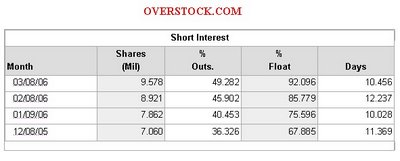
Overstock.com has issued about 19 million shares of stock. The latest short interest figures from the stock market have about 9.5 million shares short, about 49% of the total. This number is even more impressive when you figure that not all 19 million shares are available for shorting. According to Overstock, there are only 8,970,394 (10 March) registered in the electronic exchange, so that would be the theoretical maximum available to short. The reminder of Overstocks stock either has been issued as paper certificates, and not eligible for shorting unless a broker borrows them and adds them into the electronic register, or the shares have not been issued in any form by the Company.

On the surface, it appears that a huge number of shares have been illegally added to the system, most likely by naked shorting. But I wonder, can a share be borrowed more than once? When a share is purchased, it makes no difference to the buyer if the share is shorted or not. (At least theoretically) In fact, the buyer cannot tell the difference. And in their case it makes no difference (ignoring the fail to deliver issue.) if they are shares from a long or short position. Once the trade has been settled, they are in possession of the shares. So, at that point, why can’t the broker borrow those shares if they are being held in a margin account? From what I can tell, there is nothing to prevent this, and in fact it is perfectly legal. To say no would indicate that there is a difference between those shares and shares that were sold short. If that is the case, then buyers should be able to select if they only want to purchase shares being sold ‘long.’

I find that the possibility of shares being borrowed multiple times outrageous. As long as people are purchasing the shares in margin accounts, the number of shares in the market can expand mush higher than the authorized issue size. Shorting is turning the stock market into a joke. Take this sad story:

On Feb. 3, a man named Robert Simpson filed a Schedule 13-D with the SEC describing his purchase of 1,158,209 shares of Global Links Corp. (OTCBB: GLKCE), "constituting 100 percent of the issued and outstanding common stock of the Issuer." As described in a story that ran on FinancialWire on March 4, Simpson stuck every single share of the company in his sock drawer -- and then watched as 60 million shares traded hands over the next two days.

In other words, every single outstanding share of the company somehow changed hands nearly 60 times in the course of two days, despite the fact that the company's entire float was located in Simpson's sock drawer. In fact, even as recently as last Friday, 930,872 shares of Global Links still traded hands. If Simpson's claim that he owns all shares is accurate, that is a staggering number of phantom shares being traded around by naked short sellers. – Motley Fool

This would be funny if it didn’t deal with real money. This also means that the market cannot function correctly as the supply side is broken. There is no limited supply. The supply is only limited as much as the brokers limit their greed. So lets point some fingers. Who is to blame for this?

First we have the brokers. They are the gate keepers of the system. Most of us who trade electronically via the web and never talk to a broker cannot do any of this. Sure we can short shares, but it is our broker who decides if they can find the shares for us to short. Taking into account the $6 billion in failure to delivers each day, this is clearly not being done.

Then we have the The Depository Trust & Clearing Corporation. (DTCC) They act as the Clearing and Settlement System, basically it is through them that your shares will most likely pass when you buy and sell. They selling broker presents the shares for the buying broker to collect. Since most of this is taking place electronically, it is merely a matter of making entries into the books of the transfer of the shares. I would think that they share a good bit of blame since they are the maintainer of the books, they can see exactly how big a problem there is and who is contributing to the problem. (which brokers are failing to deliver.)

It would be up to DTCC to disclose the data on fail to deliver trades. One excuse that fail to deliver information is not reported is that the information may then be manipulated by traders or may expose the trading strategy of a brokerage house. This is ridiculous for two reasons. First, if a brokerage is so concerned about their trading strategy being exposed, then perhaps they should be sure to have the shares that they plan to borrow ‘in-hand’ before selling a stock short. Also, this information can be release a week, month or six months later and not risk manipulation of the market as they claim. At the moment, the information is not released as to who is failing to deliver their shares at all.

One thing that I see, is that everyone just assumes that it is the shorting transaction that fails to deliver. What happens when the person whose shares have been shorted decides to sell them? It is the broker who needs to either require the borrower of the shares to replace them or to replace them with other borrowed shares. I wonder how big a problem it is in replacing the borrowed shares? When the shares are located for a shorter to borrow, the broker makes money. Replacing the borrowed shares is just work.


This is by no means meant to be a complete post on shorting. I suspect that this story will grow over the course of this year into a good-sized controversy.

--------------------

Note: This post mentions that brokers “might” do some nasty things to manipulate the market. Of course I did not mean you, after all, that would be illegal.

Overstock Short Interest Now 107% of Float on Deposit at DTCC – Overstock
Regulation SHO Threshold Security List - NASDAQ
Dividend Tax Breaks at Risk – Fool.com

HOME

Monday, April 3

Maritime Monday #3

Thanks to all those who submitted an articles for this weeks Maritime roundup. I am proud to present this week's edition of Maritime Monday.

This Weeks Photo:

(Persian Gulf - early 1995. Photo by Fred)

This weeks items:

River of Fireflies writes in "i am! a man! of the sea!" about his search to find out how to get a job on a merchant ship.

The Yankee Sailor fills us in on "USS McCampbell Collides With Tanker in Gulf" (NOTE: Warships normally travel twice as fast and are constantly changing course.)

The Jawa Report comments on Iran's test of a Torpedo that travels faster than 200 miles/hour.

American Crusader comments about the ACLU filing a discrimination suit against the Coast Guard because it required a Muslim to remove his (religious) head cap for his license photo, which he refused. The Coast Guard has recently issued the license but the ACLU is going to sue anyway. Read the inaccurate ACLU press release here. (NOTE: Muslim Countries REQUIRE the removal of head coverings for photos, especially drivers licenses.)

Moon of Alabama in his post "TEU Monsters" has coverage and pictures of the COSCO GUANGZHOU, currently described as the world's 'biggest' container vessel.

The California Office has a post about "California's Offshore Oil Drilling Issues." I have heard a number of stories from friends working on the West (left) Coast on tankers about how idiotic California is in treating oil tankers and oil shipments in general.

An Anonymous contributor sent in the story of yet another hijacking off of Somalia. Eaglespeak has further info as well as a post pointing to the latest ONI (Office of Naval Intelligence) Worldwide Threats to Shipping Report. I get the report via email every week and it always contains a surprising amount of activity. Each report normally ends with a summary of what Greenpeace activists have been up to in the ports. (29 March report here.)

Secular Blasphemy reminds us of the anniversary of the Falklands War.

The International Labour Organization (ILO) has a Database on reported incidents of abandonment of seafarers here.

Cannoneer #4 submitted a number of items including the following:

A story in Spiegel about a research trip that managed to record record-breaking 'Monster waves' which they point out should not be confused with freak waves.

The US Navy intends to donate the Battleship USS WISCONSIN to the city of Norfolk, VA. I suspect that this donation will go better than the Navy's attempt to donate the USS IOWA to San Francisco. Gay Patriot has coverage of San Francisco's refusal to be host so such a historic vessel. One vessel that has managed to find a home in San Francisco is the SS JEREMIAH O'BRIAN. See a photo essay of that vessel here.

Cargo shippers have finally added their two cents about all of the proposed security legislation and how it will disrupt the flow of cargo. (Scanning each container will add about $125/container.) See my post here listing many of the bills submitted in both halves of Congress.

The Times UK has story covering the concerns of global businessmen in the wake of the failed DP World port deal.

Surprising to me, US Shipyards are full, and will be for at least in the near future.

Also surprising to me, is the fact that a Senator from the desert State of Nevada can put a hold on the promotion of a Coast Guard Admiral. Thankfully, Senator John Ensign will drop his opposition to the promotion of a Coast Guard vice admiral who headed Hurricane Katrina recovery efforts. Apparently the Senator might have had a problem with how the Coast Guard did not rescue pets.

Newsweek plans to intdroduce Containerization to it's readers in their 10-17 April issue.

Finally, I predicted the demise of a UN Convention concerning Seafarer Identification due to fallout over the DP World Dubai Port Deal.

Other Items:

Take a look at a map charting the recent positions of the vessels operated by Oldendorff Carriers. Click on a vessel to see the name and ccordinates.

Take a look at the view from the GRAND PRINCESS shipcam. From there you can select other Princess vessel shipcams.

Weekly Maritime Reference:
This week we visit Container terminology:

There are five common standard lengths, 20 ft (6.1 m), 40 ft (12.2 m), 45 ft (13.7 m), 48 ft (14.6 m) and 53 ft (16.2 m). US domestic standard containers are generally 48 ft and 53 ft. Container capacity (of ships, ports, etc) is measured in twenty-foot equivalent units (TEU, or sometimes teu). A twenty-foot equivalent unit is a measure of containerized cargo capacity equal to one standard 20 ft (length) × 8 ft (width) × 8.5 ft (height) container. In metric units this is 6.10 m (length) × 2.44 m (width) × 2.59 m (height), or approximately 39 m3. These sell at about $2500 in China, the biggest manufacturer. [[1]]. Most containers today are of the 40-ft variety and thus are 2 TEU. 45 ft containers are also designated 2 TEU. Two TEU are referred to as one forty-foot equivalent unit (FEU). These two terms of measurement are used interchangeably. "High cube" containers have a height of 9.5 ft (2.9 m), while half-height containers, used for heavy loads, have a height of 4.25 ft (1.3 m). When converting containers to TEUs, the height of the containers typically is not considered. - Wikipedia

Previous Edition:
Maritime Monday #2 - March 2006

Maritime Monday Carnival #1 - 20 March 2006

Submission Guidelines:
Look here for more details: Submission Guidelines

Sponsors:
No sponsors for this week. You can sponsor this week's post retroactively. Then again, if you are interested in doing that, then you might consider sponsoring an upcoming post. Check the submission guidelines for more details.

Feedback Welcomed!


Home

Saturday, April 1

Fighting Illegal Immigration: Part II

I first wrote about fighting illegal immigration last year. With Congress thinking of tackling the issue, I have some further thoughts on the matter.

For starters, take a look at the stupidity that has been passed out of the US Senate’s Judiciary Committee:

Allows illegal immigrants who were in the United States before 2004 to continuing working legally for six years if they pay a $1,000 fine and clear a criminal background check. They would become eligible for permanent residence upon paying another $1,000 fine, any back taxes and having learned English.

This sounds like amnesty to me. But wait, this will only apply to those who were here prior to 1 January 2004. So if this was to become law, it will not make anyone who has come to this country in the last two years and three months legal. That probably totals over a million illegal aliens. What will the Senate do about them? According to this bill, nothing. Of course word is probably spreading across the world that the US is getting ready to accept the illegal aliens already in the country, making this problem worse. After all, how many have heard that this applies only to those here in 2003 and before? How many know that this is not going to happen? NOBODY IS GOING TO HEAR THIS!!! Anyway it doesn’t matter. Since they are here illegally, there is no real authentic documentation of when they did arrive here, unless they were caught and released, so they can always lie about when they arrived. “I was here but I just can’t prove it.” Better yet, just generate some fake documents to document that you were here. Multiply that by hundreds of thousands of similar forgeries and the numbers themselves will give them credibility.

Of course the only reason anyone is talking about accepting illegal aliens here is because the other option is to send them back. Over ten million of them.

One common excuse against deporting the illegal aliens here already is that it would be impossible to round up and deport 12 million illegal aliens. So the solution is to let them stay, but require them to undergo a background check. Do these people have any clue how much work that is and just who the hell is going to do that? Immigration? They can’t handle all the legitimate applications they are receiving as it is.

Which sounds harder, deporting or conducting background checks? Are these people going to be required to get a physical? My wife needed one before the US would let her immigrate. You know, a physical, to make sure that they are not letting anyone in who is sick. She is from Europe and the physical alone cost over $300. It cost us over $1,000 in fees and three years waiting time to get her Greencard. This brings me to the $2,000 in fines. What kind of penalty is that? That is what many immigrants pay (and more) to immigrate legally. What happens to those who decide that they don’t want to pay the fine? This bill, if turned into a law, invites illegal aliens to commit yet another crime by lying about their past income when they are asked to pay their back taxes.

Making illegal aliens legal residents brings about another question; Are all these illegal aliens going to continue to work for the same low wages once they have to pay taxes? This is in addition to their employer taking federal deductions out of their pay. Some of them would be due for a pay increase if they were not paying at least minimum wage. This brings about a problem; Illegal aliens are not going to be so inexpensive if they are no longer illegal. This in itself might bring about a new wave of illegal aliens to fill the jobs that will only pay very little.

A Massive Roundup is Required:
Turning illegal aliens into Legal Residents just won’t work. Even if they are all offered Legal Residency, many will not comply will the conditions imposed, instead remaining as an illegal aliens, (starting with the criminal element) which means that we are still going to have to expend a huge effort to find, and deport these people. With that in mind, the US should step up efforts to deport all illegal aliens, including those from Mexico.

Don’t let the size of the problem be a reason not to solve the problem. Look at law enforcement. The more money to put into it, the more results you get back. The number of illegal aliens caught will go up dramatically by increasing the funds to catch, hold, and deport them. Take running red lights and speeders. There is no way that police can catch them all. Did the police give up? No, they got smarter. Now we have red light and speed cameras to aid enforcement. Same with deporting illegal aliens. We start sending them back, and the word will get out that it is no longer so easy to work and live here. This will have the result of reducing those who even bother to try and cross into the US.

Most people are not even aware that a million illegal aliens WERE CAUGHT in 2005 at the border. If 11,000 border agents can catch a million illegal aliens at the border, then hundreds of thousands of police across the country can manage to catch sizable numbers of illegal aliens. We catch many now, but many are let go with only a notice to appear in court for a hearing which they will never appear for.

Build the Border Fence and extend the Threat of Capture:
To further reduce the amount of illegal aliens coming into the US, there needs to be a border fence as well as enough personnel to catch AND HOLD those who attempt to cross. It is apparently too easy to cross into the country from Mexico. This needs to stop. A fence alone will not be able to stop this flood of people unless the threat of being caught continues once they are inside the US. Currently this is not the case. You will never be able to control people coming in illegally if they think they think the threat of being caught only exists while crossing. The threat needs to be constant and ongoing.

We must continue to hunt down illegal aliens once they are inside the country. Now, if they can make it onto the country, they are home free and have no fear of being caught. Look at the protest in Los Angeles. They were not concerned. The protest did prove one thing though, that it is possible to round up large numbers of illegal immigrants.

The threat also needs to be extended to employers who use these workers, if a business can only supply by using this type of labor, then it is not a viable business. There needs to be massive enforcement and if it causes the business trouble so be it. My company employs many foreign born as we are an international business. The company has a lawyer to ensure that none of the employment records contain fraudulent or doctored documents. This is not hard to do. You probably don't even need a lawyer, only a person who will not accept obviously fake documents and willing to ask the question "Where is your Greencard?"

Increase Legal Immigration:
If we as a country are willing to accept 12 million new residents, they why not open those spots up to people around the world. America is a melting pot. To say yes to millions of Mexicans and no to the rest of the world is a crime of huge proportions. To say yes to these twelve million illegal aliens is to say yes to permit every single person in Central and South America into the country. We do not have room for all of them. To say yes to all of them is to also say yes to everyone in Africa as well as to every inhabitant on this planet living in poverty. We can’t accept everyone, at least not at once. We have to draw the line somewhere, and that is our decision to make, not anyone else’s, especially someone who has already broken our laws. Alternatively, we can always redraw the line, either including Mexico or excluding Southern California.

Concerning Jobs American’s Don’t Want:
If Americans will not do these jobs, then perhaps these are the jobs that should be outsourced from America. Farmers can purchase farmland in Mexico and meatpacking plants can establish plants in Mexico. We are sending jobs out of the country; why not export the jobs ‘we’ as Americans don’t want. As it is, NAFTA has provided many jobs in Mexico. There is even concern that there are not enough Mexicans to fill them all, creating of all things, wage inflation in Mexico.

There are reports that there are millions of Americans with only a high school diploma or less, who are either unemployed or not even looking for work. These people will be most likely to benefit, as employers would need to turn to them to fill the demand for workers. It does not matter that they do not want these jobs, with their education level, these are the only jobs available to them.

After watching the TV Show ‘Dirty Jobs’ I doubt that there is such a job that at least some Americans will want. This has been documented. Illegal aliens do work in professions that Americans also work in.

Illegal Alien Labor Creates an Imbalanced Playing Field:
When an employer uses illegal labor, his costs are now lower than his competitors, giving him an unfair advantage. This now forces the others to adopt the same practices, legal or not, just to survive. The wage levels for those jobs is reduced, driving out the Americans that were doing the work, increasing the demand for the illegal workers.

Protest in your own damn country:
You’re here illegally and your complaining that you don’t have the rights that you think you are entitled too? Maybe the situation is not as you wish it to be because you are not where you should be in the first place. Sure there are plenty of things to protest about. Too bad you should have started protesting back home about the lack of opportunity there.

This is not the Path to Citizenship:
People wanting to become American Citizens carry American Flags, not Mexican ones. It makes you wonder, do they want America to be more like Mexico or do they want Mexico to be more like America? If Mexico is so damn great, they why are hundreds of thousands of Mexicans willing to risk their lives to get to America? If you looking to reclaim the southwestern US for Mexico then you should have come here with a gun, not looking for a job.

Before you can apply to become a citizen, you need to first apply to be a legal resident. This application is received by our embassy and consulates in your country. If you are rejected, take heart that you are not the only one. Many more people want in than there are spaces. Yes, I agree, there should be more spaces, bt only for those following the right process.

You Have made life much more difficult for all those following the rules
Many people would love to immigrate to the US but sit in their own country waiting for a visa or green card approval. There are not enough spaces for those who wish to come. You have decided to cut in front of everyone and stake your own claim here. Worse yet, every Mexican who has come here legally is now treated as if they are just another illegal alien, because there are more of you than there is of them.

The Mexican Government is part of the Problem.
Mexico is doing nothing to stem the flow of people crossing out of their country. In fact there have been some suspicious incidents that Mexican Border Officials are actually aiding illegal immigrants across the border as well as moving drugs too.

Every Mexican that makes it into the US is one more person sending money back into Mexico. So it is in their best interest to do nothing. The President needs to get tough on Mexico and find a way to make it in their best interest to stop people from walking out of the country. How about imposing a fine totaling a certain amount for each Mexican national caught crossing the border. The funds can be collected in the form of tariffs. We must have something that we can hold over their heads. It is time to use it, especially considering that President Fox just rejected the idea of doing anything to prevent Mexicans from crossing into the US.

Mexican President Fox is pressuring US President Bush to accept millions of illegal Mexicans while at the same time refusing to stop the flow of ever more illegal aliens. That takes balls. Bush should tell Fox to forget any the guest worker plan as long as he refuses to be part of the solution. In addition, he should tell Fox that he’s going to send every last illegal Mexican alien back and every person we catch crossing the border is going to be sent back and we are going to bill Mexico for the expense. (I can imagine Bush explaining in the private meeting with Fox how he sees a huge slide being erected over the fence to return illegals with)

Illegal aliens from Mexico should not be treated differently from non-Mexicans. The largest flood of illegal immigrants is coming from Mexico, so it makes sense to concentrate our efforts in catching them. This way word spreads in Mexico that it is more likely that you’ll be caught and sent back. Currently, many Mexicans that are caught within the US are released due to storage constraints. That needs to stop.

At a minimum, can we at least ask Mexico to teach it’s citizens English? that would increase their usefulness, and get them on their way to Us Citizenship.

Assets should be seized:
Don’t pay your taxes and the IRS will be out to get your stuff. This should also apply to illegal immigrants. How’s that for a threat.

Deny Services to Illegal Aliens:
States need to deny illegal immigrant documents. The Mexican “Matricular Consular” is used as an excuse to permit service to illegal aliens, such as opening bank accounts, even though it is well known that these documents are completely unreliable according to the FBI, and Congress.

Illegal Aliens who are criminals should do their Prison Time Here:
Illegal immigrants who are arrested for crimes, other than immigration crimes, should do their prison time here. We should not be exporting real criminals back to their home countries, especially if they are going to be immediately released onto the streets once they get there.

The only amnesty offered should be time to leave the country without penalty:
Illegal aliens should be given time to leave the country without facing a criminal record. This should only apply if they do so willingly. Enforcement should start immediately. This way it becomes immediately clear that the threat is real.

This is not about Racism:
I have seen the charges. All of us calling to crack down on illegal aliens are racists. That is simply not true. Some are but most are not. This has nothing to do with racism. This has to do with control or more appropriate, regaining control of our country's immigration. Would the country be complaining if there were 12 million blonde Swedish Women here illegally? No, but that has nothing to do with racism, that is just sexist. (As well as pure fantasy.)

It is not our fault that things suck in your country. Fleeing your country will not make things better there.

Center for Immigration Studies - "Dropping out" Study
** How Do You Deport 11 million? - Ogre's Politics and Views **

-------------------

My Original Post from June 2005 Follows. At the time I advocated a guest worker program. After the recent discussions, I am shying away from this type of program and more in favor of increasing legal immigration. There are more than enough people on this planet who want to move here and work towards becoming Americans. Why not grant more of those wishes instead of creating a second class of worker.

Fighting Illegal Immigration is easier than anyone is willing to admit - 18 June 05

We see it on the news night after night. The country is being overrun with illegal immigrants. There are over ten million illegal immigrants living in the US. Eleven percent of all Mexican Citizens are living in the US, half of them illegally.

This situation is insane. I am not exactly sure how the country got itself into this situation, but you can guess that it is a problem that has been slowly growing for years. Now many admit that our borders are broken. Many are resigned that there is nothing that we can do. There are too many to stop. This is a defeatist attitude and wrong. We all can see that there is a serious problem, and it is a problem that needs to be fixed. Are our borders broken? I want to think that they are more leaky and that a couple changes in policy and tactics will do a good deal to stem much of the leaking, and allow the US to control the problem, as it should be doing.

Changes to the system:

First, we will need more immigration agents.
This is the most obvious needed resource and steps have been in the works to address this need. Now there are experts who claim that added reinforcements at the border will not stop the flood of illegal aliens flowing over the border. I agree it probably won’t so this is not the goal of these changes. The goal of these changes is to create a border secure enough to discourage enough people from even trying to cross into the US illegally. Right now there is no deterrent. The following changes in policy would change that.

End 'catch and release' both at the border and anywhere inside the US.
As I just mentioned, there is no deterrent against trying to cross the border. If you get caught the worst that will happen is that you get a free ride home to your home in Mexico. Many who are caught are simply given an appearance ticket to appear in court and are quickly let loose onto the streets of the US. We all know what happens next, they disappear. This needs to stop. These people have committed immigration crimes and need to be put in front of a judge. Every single one of them is a flight risk and should not be let out on bail. Worse yet, none of those who are caught are asked to put up any bail, they are simply let go. They should all be held until a judge decides what to do with them. If we as a nation are not willing to do this, then we need to be ready to deport every illegal alien we catch. This will probably take as big an effort as detaining them until their trial.

Right now at our airports people arriving by plane are put in chains and deported for overstaying their visa limits during a previous visit. In some cases the overstay was only one day. From where are these people coming from? Countries with Visa-waiver status. Countries like Finland, and the United Kingdom. This is overkill. How many immigration agents does it take to deport these isolated cases? The manpower requirements far outweigh the results. Shouldn’t some of these assets be reassigned where they can stop hundreds and even thousands trying to enter the country illegally.

Utilize Local Law Enforcement
Just because you manage to get past the border guards does not give you a free pass to stay in the country. Every day illegal aliens are caught by local police, only to be let go because the police are not in the business of enforcing immigration law. Police in California were being harassed by pro-immigration forces to stop setting up drivers license and DUI checkpoints. In addition to catching drunk drivers they had the added bonus of catching illegal aliens since they are unable to obtain drivers licenses and insurance. The pro-immigration forces defend these people who “otherwise obey the law.” Yes, other than immigration and motorist law. Better yet, the pro-immigration forces attack the check points because they “discriminate against those without licenses.” If that is the case, we will have to disband the police since they discriminate against those who break the law. At least in this case sanity prevailed and the checkpoints were resumed and now unlicensed drivers cars are towed away. The only thing missing now is the need to take the illegal alien who was driving the car away too.

So where do we put all of the illegal aliens that we catch? Well the US has experience in handling hundreds of thousands of prisoners. During WWII many prisoners of war were shipped from Europe back to the US for internment. This mass detaining has been done successfully before and it can be done again. Some of these new border agents the government has been promising can be used for this purpose.

At first, a huge number will be caught, but then it should slow down. Perhaps even suddenly. Some decrease can be expected, simply because those who are caught cannot try again immediately like they do now. Secondly, many others would be deterred from even trying to cross into the US because they are not interested in sitting in an internment camp for six months.

Prosecute all who are caught
Now we would not just intern them, they would be interned awaiting trial. Of course they would have the option of pleading guilty and then being deported with a warning. Penalties for those caught a second time should be harsher. Perhaps they would be incarcerated for a year. Perhaps just another six months to work their way through the system would be enough. The second time you would not be able to simply plead guilty to get out. How many Mexicans would cross the border if they knew there was a reasonable chance that they would be caught and denied income for a half-year? Truly something to think about before deciding to go north.

Families of mixed immigration status should not be exempt
Illegal alien parents of American born should not be exempt from immigration law. Many illegals living here have American-born children. It is not fair to punish the baby and I doubt that it is possible to deport and American-born child. Nor would I want to. But the parents do need to be punished. There are two ways I can think of doing this. One way would be to deport the parents when the child reaches 18 years of age. The other is to give the parents a suspended sentence to be served when the child is no longer a minor.

End the 'We cannot get by without them' Myth
One defense against going against all the illegal aliens is that we cannot get by without them. This is a load of bull. There is room here for a formal guest worker program and one should be instituted. Notice the word ‘formal.’ What we have now is a free for all and all of these workers are outside of our legal economy. How many illegal aliens are unemployed? How many are underemployed? How many pay taxes? All of their employers are contributing nothing to the Social Security and Medicare programs. We are all being cheated by this activity as our contributions (tax and otherwise) then get used to support them.

A guest worker program will do not only the US good but it will also benefit Mexico. It will enable Mexicans in the US to travel back and forth between the US and home and permit the spending of more money in Mexico, helping the economy there. This will also help American firms that do not utilize the illegal workforce compete because heir competitors will lose the cheap labor that they had been utilizing to beat their competition.

Proclamations that the US cannot function with this shadow workforce are insulting. At best, this low-cost workforce is preventing the implementation of more efficient machinery and more productive methods.

Conclusion
I know that much of what I have written will be seen as drastic and I will be dismissed as the work of an extremist. I can assure you that I am not an extremist. As a matter of fact I have lived outside the US and my wife is a foreign national. I am familiar with being an immigrant through living and working overseas. I have been detained in another country and deported. (Long story.) My wife has been detained in the US also.

For three years we have been dealing with immigration on a number of matters. Mis-spelling her name on her green card. Losing her green card when it was returned for correction. Being forced to pay for a replacement card which was then never issued. Being told conflicting information concerning the application process and very simply, being lied too.

The process to come to the US sucks. However, this is not a reason to skip the line and the process. Many others are waiting to come here legally. Some will wait for years and it makes sense to have limits, and ours are very generous. An orderly and planned immigration policy allows immigrants to integrate into society.

I know very well that you get punished for doing things legally. It is expensive to go through the green card process. My wife is prohibited from collecting any government assistance. This includes welfare and unemployment. If she attempts to apply for this aid, I can be prosecuted, even if we get divorced. So I am furious to see all of the federal money go to aiding illegal aliens here. Hundreds of millions of dollars are provided by the Federal Government to treat them in hospitals alone. Dollars that can be better spent policing the border and catching (and holding) those who manage to cross it illegally. The question is when do we seriously start to enforce our immigration laws?

Tuesday, March 28

Dubai Port Hysteria Kills UN Seafarer Identity Convention

The International Labour Organization (ILO) is a United Nations “agency which seeks the promotion of social justice and internationally recognized human and labor rights.”

The ILO formulates international labor standards in the form of Conventions and Recommendations setting minimum standards of basic labor rights: freedom of association, the right to organize, collective bargaining, abolition of forced labor, equality of opportunity and treatment, and other standards regulating conditions across the entire spectrum of work related issues.

One item that the ILO has under its wing is Seafarer Identification. Since seafarers travel around the world and don’t always know where they are going, it is often difficult, if not impossible, to obtain the right visa before arriving at a port. This is where the ILO comes in, with a Convention that sets the rules for seafarer identification to permit the movement of seafarers with limited restrictions/visa issues.

The old Convention was passed in 1958, and after the terror attacks of September 11, it was realized that an updated convention was needed. So in the summer of 2003 the new Convention (Number 185) was adopted and it came into force on 9 February 2005. There is just one small problem, the US does not like the new Convention. Specifically, they don’t like the following clause in the Convention:

Shore leave

4. Each Member for which this Convention is in force shall, in the shortest possible time, and unless clear grounds exist for doubting the authenticity of the seafarers' identity document, permit the entry into its territory of a seafarer holding a valid seafarer's identity document, when entry is requested for temporary shore leave while the ship is in port.

6. For the purpose of shore leave seafarers shall not be required to hold a visa. Any Member which is not in a position to fully implement this requirement shall ensure that its laws and regulations or practice provide arrangements that are substantially equivalent.

The problem here is that the US does require visas for seafarers wishing to go ashore in US Ports. In the past they used to issue Crew Visas that were issued to the crew upon arrival. This is no longer possible. Therein lies the problem. If you are a seafarer and you are coming to the US, you need to get a visa before you join the ship, especially if you plan on joining it in the US. Immigration won’t let you into the Country unless you have a visa. This Convention tried to eliminate the Visa requirement in the US or at least force the US to make it easier for seafarers to get a visa once here.

I have been told that those negotiating this Convention were warned by the US not to include the visa clause but it was included anyway by representatives of the seafarers, who, in the way the ILO is set up, have a say in the negotiations. The joke is that the new convention was created for the US, and now the US will not sign it. Since they have not signed it, other countries are not willing to commit to it. After all, at least 60% of global shipping involves the US. Without the US, this convention will have a hard time gaining acceptance.

Let’s look at who has ratified this convention:

France
Jordan
Hungary
Nigeria

Do you think there is a problem here? If the US signs up, then (unless they can prove that the seafarer is a National Security threat) the US will have to permit all seafarers with a valid seafarer ID entry into the US. One of the four countries to ratify this Convention is in the Middle East. Another is Nigeria, which has problems preventing their own citizens from kidnapping/attacking foreigners working in their own oil fields. They also have also managed to let the former president of Liberia, Charles Taylor, escape from their ‘protective custody’. Mr. Taylor is wanted for crimes against humanity and is the only person to be charged with war crimes while a serving head of state other than Molosovich.

The latest country to ratify this Convention was Hungary which ratified the Convention in March, 2005. (So there have been no new ratifications in the last year.) If the US ratifies this Convention, then they would be pushed to accept foreigners from all other countries that also ratify this Convention. That includes countries like Saudi Arabia and Iran. Both countries are already on the International Maritime Organization’ ‘White List.’

The ILO has been trying to get the US to commit to ratification of this convention with little success so far. I suspect that this Convention is all but dead, taking into account the reaction of congress in the DP World Port ownership issue. Imagine the furor in congress and the public if it is suggested that they sign up to an international convention that will result in seafarers from around the world (including North Korea and Iran) into the country without proper due diligence.

C185 Seafarers' Identity Documents Convention (Revised), 2003 - ILO

Monday, March 27

Maritime Monday #2

I start this week with a confession. This weeks carnival had no submissions. With that in mind, I have removed 'Carnival' from the title, and instead I am proud to present this week's edition of Maritime Monday. This week contains links to blog post found that I think you might find interesting.

This Weeks Photo:


All the Cruise Vessel mishaps this week reminded me of a Survival Craft exam I gave in Miami in 2001. It is not regular work for me. I was asked if I could fly down at the last minute as the regular inspector was not available. I am not one to say no when I get a chance to take a lifeboat (survival craft) for a spin.

It was a group test, the students working together, and in the end they all passed save one. The group being tested was hotel staff. You see, there are so many lifeboats on a cruise ship, that there is not enough seafarers to mann all the positions. So the hotel staff is called upon to mann some of the positions. At the start of the exam, the Chief Mate was a little too involved in the exam as a coach, so I stopped the exam for a minute and proclaimed the Chief Mate 'dead'. They managed to do fine without him. (Photo by Mrs. Fred.)

This weeks items:

The Estrogenius Radio Blog has a post about Rogue Waves.

EagleSpeak has coverage of a truly impressive eplosion that took place on the HYUNDAI FORTUNE. More coverage of this incident at Cargolaw.

The Monitor has coverage about the sinking of the Canadian Ferry QUEEN OF THE NORTH in British Columbia. More coverage of the sinking at The Galloping Beaver including an estimated position of sinking.

Sailors, Mariners & Warriors League cover another 'North' vessel (no relation) in trouble where the EMPRESS OF THE NORTH, a sternwheeler cruise vessel has run aground in the Columbia River. Oddly enough, the passengers abandoned ship directly onto another sternwheeler, the QUEEN OF THE WEST.

Gates of Vienna has a post covering the well-publicised P&O STAR PRINCESS fire. If one cigarette can cause all that damage. Imagine what a pack of cigarettes in the hand of a terrorist can do...

Fires, sinking, and running aground are not the only dangers of going to sea. Cruise Junkie has a running list of Persons Overboard from 1995-2006. They also have a list of all sorts of events that happen to and on cruise vessels.

Blue Mountains Union News has a story about longshoremen on the guard against foreign-flag cargo ships taking cargo containers destined for other Australian ports, which should be carried only by Australian-flag vessels.

Sake Light has a post about Piracy in International Waters and the role of the US Navy.

Admiralty, Boating, and Maritime Law Podcasts has this video of a collission between a Greenpeace vessel and a Japanese whale 'research' vessel. (No comment concerning Greenpeace's actions for the moment.)

Weekly Maritime Reference:
This week we visit the legal term "General Average." A good definition of General Average:

An ocean marine loss that occurs through the voluntary sacrifice of a part of the vessel or cargo, or an expenditure, to safeguard the vessel and its remaining cargo from a common peril. If the sacrifice is successful, all interests at risk contribute to the loss borne by owner of the sacrificed property based on their respective saved values.

Basically, there is an accident on the vessel and in trying to save the vessel, cargo is jettison or somehow damaged or destroyed in the process of saving the ship. Like water damage from fighting a fire. Or tossing cargo over the side to get access to a damaged part of the ship or the cargo causing the distress. The actions were successful in that the ship is saved. However, not all of the cargo owners are getting their cargo. As their loss resulted in the other cargo-owners getting their cargo, those cargo owners must compensate the ship and other cargo owners for their loss, essentially all lose equally.

Previous Edition:
Maritime Monday Carnival #1 - 20 March 2006

Submission Guidelines:
Look here for more details: Submission Guidelines

Sponsors:
No sponsors for this week. You can sponsor this week's post retroactively. Then again, if you are interested in doing that, then you might consider sponsoring an upcoming post. Check the submission guidelines for more details.

Feedback Welcomed!

Sunday, March 26

Traffic Light (with instructions)

Just how stupid is this country becoming? I ran across this traffic light in Queens, NY on Saturday.

(Wait for Green Light)

Am I the only one who thinks that if you do not know this, then you should not be behind the wheel of a car.

How many of these idiotic signs are posted in New York City?

Carnival of the Clueless

Saturday, March 25

New French Labor Law Permits firing of Bad Employees

Once again France is being torched by protestors. This time it is over what I would consider a law that is probably desperately needed in France, if not elsewhere.

The CPE was introduced as a way to tackle the high level of unemployment for young workers. French employers can hire workers under the age of 26, but can also fire workers without just cause within the first two years of employment. - Jurist

This is very simple issue. As an employer, I have an open job. I want to fill that position with the best person that I can find.

The last position that I had open, I eventually offered the job to the ninth temporary employee that we had doing the work. Two of the other temps quit, mainly because they were overqualified. The other six I fired. They were either too stupid, or too set in their ways, or just not interested in doing work. They needed a paycheck, but did not feel like working. Any one of these six would have made our office a miserable place if we had been forced to keep them.

Yes, they were stupid.

It is a hassle to hire a new clerk. The job is not difficult but it does require learning and it requires some competence on the part of the employee. It also involves contact with clients from around the world, which requires a certain degree of understanding as English is a second language for many of the clients. It is not required that they have this understanding when they are hired, but that they can learn how to work with these clients. They are however required to have general knowledge of world geography; Finland is in Europe. Canada is not part of the United States (yet). China and Taiwan are in fact two different Chinas, etc. Of course we are all not operating in the same time zone either. It is amazing how poor people's understanding of geography is. (not to mention their math and writing skills.)

We dedicated lots of time in an attempt to train each one of these temps. We want them to succeed, after all it is in all our benefit to get the new employee trained and contributing to the job at hand. So to decide to fire someone means that we have to start over again. That is a difficult thing to do to your staff.

Our office staff is part of a team. To think that a person is fired simply by the decision of a person in a corner office is silly. People get fired because the people they work with want them gone. How often is a great co-worker fired from your office, other than for cause? In all the cases but one, the person was fired because of complaints and feedback from the staff. So it was the coworkers who fired these people. It was just me who agreed with their criticism and pulled the trigger.

For the person looking for a job, this is a great rule. You see, you are competing against people more stupid (lazy) then you. Why should they get to keep a job just because they tricked those who hired them, or because they have a friend in the human resources department. So either you need to do good work, or your out while they look for a better employee. Think of it as an extended job interview.

This now permits companies to take a risk in hiring you. If it is a mistake they can just get rid of you. In the cases where they are looking to hire multiple people, they can fill both positions immediately, instead of waiting to see if the first choice was good or not. Instead of leaving positions empty, they can hire for those positions without the fear of being stuck with poor choices.

So who is rioting over this law in France? I am not sure, but I would not interested in hiring any of them. They do not look like people over 26. If anyone should complain, it should be those over 26. The law will not permit firing these people, so I would think that companies would be less likely to hire then than someone they can just get rid of.

In Virginia, there is a right to work law. Employees can be fired for no reason. In the five years working for the company, every employee that was fired, was fired for cause. In other words, they should have been fired. Employees do not feel like there is this constant threat of being fired. That is not the atmosphere at all. They know that the company needs them, because they are good workers.

The Virginia law also permits employees to quit with no prior notice. For every employee that has been fired at my company, at least two have quit with no notice. So I would think that employees benefit more. They can look for new work and if they find something, they just stop coming to their current job.

What is wrong with a company firing an employee anyway? Companies that abuse this right will find themselves in trouble.

Labor law talks between French PM and unions end in deadlock - Jurist
Paris Burning, Once Again - Washington Post
Concerns over violence intensify in France - International Herald Tribune

Sunday, March 19

Sanborn-Snow-Bush Conspiracy 'Dot' Connectors have Dull Pencils

I just noticed that a number of left-leaning sites are trying to 'Connect the dots' on some sort of maritime conspiracy running around the Bush White House that the Dubai Port Deal has somehow brought up to the surface. Of course it is the Democrat members of Congress who seem to think that this might be the next thing to throw against the wall to see if it will stick against the President. After all, word has been out for a while that the Democrats plan to impeach the President 'when' they get control of Congress in November. Thankfully that won't happen, but try telling them that. So they continue to build their list of charges against him.

Enter David Sanborn, who is the President's nomination to be the next Maritime Administrator (MARAD). Democrat Senator Bill Nelson does not like the President's pick and is going to see if he can increase the Dubai Port kill-zone by torpedoing the President's pick to head the Maritime Administration, a part of the US Department of Transportation. Senator Nelson gives us this classic concern:

Nelson said he is troubled that if Sanborn is confirmed as head of the US Maritime Administration, Sanborn would be overseeing his former employer's work at US ports. But the Maritime Administration issued a statement last night saying it ''does not regulate US ports, their operations, or their security." Instead, the administration said, it collects port traffic data and advises on issues such as dredging, congestion, and environmental guidelines.

Apparently the Senator has NO CLUE how small the US Maritime Community is. It's small. Really small. Everyone knows everyone else. When you go to training courses you run into many people you have met before. Instead of 'Six Degrees of Separation' American Merchant Mariners (Seafarers) have Three Degrees of Separation. (any US Merchant Mariner can be connected to any other US Merchant Mariner through a chain of acquaintances that has no more than one intermediary.) To compare, the US Naval Academy admitted 1,220 Cadets this last year. The US Merchant Marine Academy admits about 275 Midshipmen each year. A much smaller group, but then again, your only putting a handful of seafarers on each ship, not hundreds like in the Navy. Don't think that those who leave the Navy end up in the Merchant Marine or the maritime industry. Few make the transition. The training and experience in the two fields is completely different.

I find this conspiracy theory very amusing since I too:

- I Have worked for SEA-Land Services. (which was owned by CSX)
- I Have worked for P&O Containers.
- I have also spent two weeks assigned to MARAD (All before my 34th birthday)

To put things in perspective. SEA-Land was the shipping line started by the creator of Containerization. Many of the country's Maritime Experts (Container-shipping related) have worked for SEA-Land. What really gets the conspiracy theorists going is that Secretary of the Treasury, John Snow, is a former Chairman and Chief Executive Officer of CSX Corporation, the former owner of Sea-Land. He took the position in January 2003. In late 2004 CSX sold it's "CSX World Terminals" to DP World. Now lets look at Mr. Sanborn's Bio from his nomination:

The President intends to nominate David C. Sanborn, of Virginia, to be Administrator of the Maritime Administration of the Department of Transportation. Mr. Sanborn currently serves as Director of Operations for Europe and Latin America at DP World. Prior to this, he served as Senior Vice President for North America Service Delivery at CMA-CGM (America) LLC. Mr. Sanborn also served as Vice President for Network-Operations for American President Lines, Pte. Ltd. Earlier in his career, he served as Director for Operations for Sea-Land Service, Inc. Mr. Sanborn is a retired Lieutenant Junior Grade for the United States Naval Reserve. He received his bachelor's degree from the United States Merchant Marine Academy.

All we have here is a person with a career full of experience relevant to the position he is being nominated to. Strange, the Democrats were just complaining that the President is making appointments of unqualified persons. (F.E.M.A's 'Brownie' for starters.) This is yet another non-story. Too bad Senator Nelson and Senator Kerry have bought into it. Remember Senator Kerry?

Kerry, in a letter to Snow, wrote that, ''As you know, the CSX rail corporation, where you previously served as chief executive officer, sold its port operations to DP in 2004." Congress needs to learn ''whether administration officials could have unduly influenced CFIUS's approval process," Kerry wrote.

I tried to find Senator Kerry's 2004 comments about the sale of CSX to a Dubai firm on his website, but the search for "CSX" came back with no hits. Guess he did not find a problem with it at the time (At what point after 9/11 did port security become important?) Did you notice that Kerry is suggesting that Mr. Snow might have committed a crime? Nice guy eh?

P.S.
So far none of these conspiracy theorists have managed to link White House Chief of Staff Andrew Card to the conspiracy yet. That surprising since:

- Mr. Card served as the 11th U.S. Secretary of Transportation (92-93)
- He attended the United States Merchant Marine Academy

The 'moonbats' have had Rove stuck in their sights for years. I have always believed that Rove is the decoy. It is Card that is the Ringleader of the whole Administration.

P.P.S.
If you really whant to find a conspiracy in the UAE Port Deal, how about looking at how the Clintons tag-teamed DP World, the company buying P&O Ports.

Mrs. Clinton, Senator from the State of NY raises a stink about the Company buying Terminal Operations in the US. Enter her Husband and ex-President, Mr. Clinton, who takes in anywhere from $0 to $400,000 in consulting fees to help steer the company through the Congressional objections to the deal. Technically, nothing illegal was done as Mr. Clinton didn't infuence Mrs. Clinton to change her mind. Neither one of them has any knowledge of ports, or port terminal operations, or containerzation. Yet there they were right in the middle of this mess. Now President Clinton explains how he was always on the same page as his wife.

“I told them I couldn't understand why they wanted to do this, given all the problems we have with port security,” said the former president. “I thought there would be tremendous public and Congressional opposition. If they were determined to press ahead, I thought they should not push the process, but should open it up, and they should actually propose things that would increase port security.”

Clinton says he never asked anyone to support the deal, and he says Dubai Ports World never compensated him. - NY1

Where did all those other stories about the ex-President's involvement in this deal on behalf of the UAE Company come from? Now, if the press bothers to check, it seems that President Clinton might have broken the law advising them, even for free.

Apparently, Department of Justice lawyers from the Office of Legal Counsel want to know if Clinton registered as an "Agent of a Foreign Principal." According to the American Prowler, "Federal statute requires that anyone -- even a former President -- doing political or public affairs work on behalf of a foreign country, agency or official must register with the Department, and essentially update his status every six months. It was not clear Clinton had done so." - NMJ

The newest information available is from the second half of 2004 at it does not appear that Clinton's firm is listed. It will be interesting to see if Clinton's Business is registered. Don't wait for the press to tell you. Now lets all forget all the American Businesses sold to foreign entities while Clinton was in office.

UPDATE: 28 March 2006
Mr. Sanborn has withdrawn his nomination.

MarAd candidate Sanborn pulls out

DAVID SANBORN has asked President Bush to withdraw his nomination to head the US Maritime Administration and the While House has complied, pulling his name from consideration. The announcement came late Monday as Bush sent four unrelated nominations and one other withdrawal to the Senate. Sanborn, a former executive with Dubai Ports World wrote in his letter to Bush that “the convergence of a number of factors bring me to the conclusion that I cannot effectively serve my country, you, and the U.S. maritime industry." He was nominated to head MarAd in January, before the DPW furore began, but became caught up in the hysteria when Sen. Bill Nelson, a Florida democrat, held his nomination hostage to the company’s sale of US terminal contracts. Sanborn, a Merchant Marine Academy graduate and navy veteran, had over 30 years experience in the maritime field and also said in his letter that his “background makes me one of the most qualified people there is for this position” of MarAd director. No replacement nominee has been tendered, leaving acting administrator John Jamian in charge of the Department of Transportation agency that he has run for over a year since Capt. William Schubert resigned. Lloyd's Register - 28 March 2006

--------------------
Agency nominee taking Senate heat - Boston Globe
Climate of Corruption II - New Media Journal
Foreign Agents Registration Unit (FARA) - US Department of Justice